Pendraig
"chief dragon"
Type species Pendraig milnerae
- Lived
- 237 to 227 million years ago, Late Triassic
- Diet
- Carnivore
- Group
- Theropods
- Found in
- United Kingdom
- Named by
- Spiekman et al. 2021
Where its fossils were found
The evidence
Today

230 million years ago
Habitat
It probably lived on a small limestone island in a warm archipelago in what is now Wales. Its neighbors included Pantydraco and small crocodile relatives.
Field notes
About Pendraig
What it was like
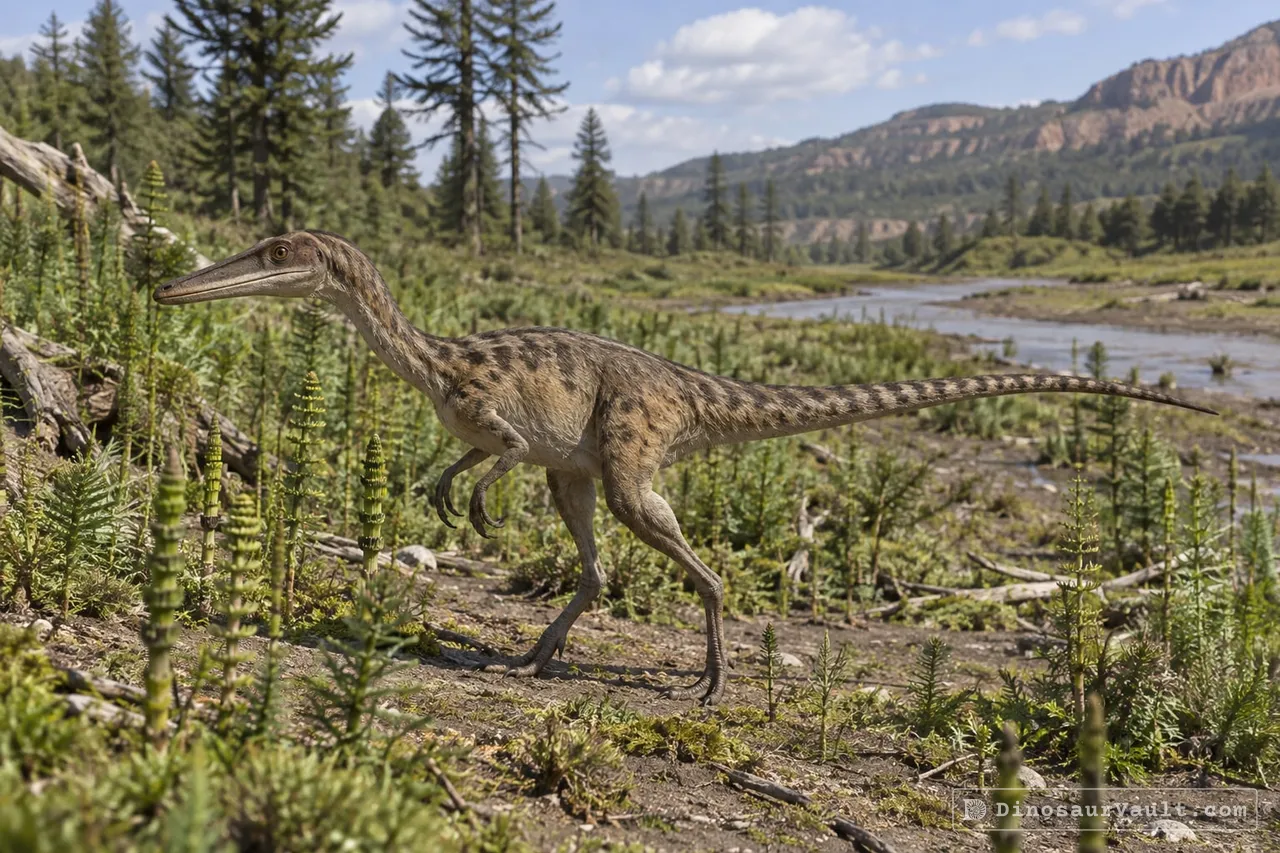
Pendraig was a small, slender meat eater only about the size of a large cat, related to Coelophysis. It walked on two legs and had sharp teeth.
It is one of the oldest meat-eating dinosaurs known from the United Kingdom.
Its world
It lived in the Late Triassic in what is now Wales. Its bones come from a quarry where cracks in limestone filled with sediment and bones, the same kind of site that produced Pantydraco.
How it was found
Spiekman and colleagues named Pendraig in 2021. The bones had been collected decades earlier and kept in a museum drawer. Its name comes from an old word of Wales meaning chief dragon.
Field gallery
More views of Pendraig
Scenes reconstructed from the available fossil evidence.
1 of 3
The evidence
The science behind Pendraig
Which parts of the picture come from its own bones, and which come from its relatives.
From its own fossils
- The main skeleton preserves part of the backbone, the pelvis and a thigh bone.
- The hip bones have a distinctive outline, including a sharply angled rear tip.
Borrowed from relatives
- Its missing head and limbs are restored from early theropods such as Coelophysis.
- Blade-like, serrated teeth and a meat-eating diet are inferred from other coelophysoids.
Still unknown
- How large a fully grown adult became.
- Whether island life caused its small size.
- Its skin covering and color.
Discovery timeline
- 2007Fossil sitesWHITESIDE & MARSHALL
- 2021Named itSpiekman et al.
Key papers
The research behind what we know of Pendraig
Fossil sites
Used pollen and other tiny fossils to date related bone-filled limestone cracks and reconstruct their coastal setting.
The age, fauna and palaeoenvironment of the Late Triassic fissure deposits of Tytherington, South Gloucestershire, UK. Geological Magazine 145: 105-147
Read the paper : The age, fauna and palaeoenvironment of the Late Triassic fissure deposits of Tytherington, South Gloucestershire, UK (opens in a new tab)Named it
Identified a small early theropod from a partial skeleton and examined whether its size reflected youth or island dwarfism.
Pendraig milnerae, a new small-sized coelophysoid theropod from the Late Triassic of Wales. Royal Society Open Science 8
Read the paper : Pendraig milnerae, a new small-sized coelophysoid theropod from the Late Triassic of Wales (opens in a new tab)
Close relatives
Other members of Coelophysoidea


Sources: Wikidata