Dracoraptor
"dragon robber"
Type species Dracoraptor hanigani
- Lived
- 201 to 200 million years ago, Early Jurassic
- Diet
- Carnivore
- Group
- Theropods
- Found in
- United Kingdom
- Named by
- Martill et al. 2016
Where its fossils were found
The evidence
Today

200 million years ago
Habitat
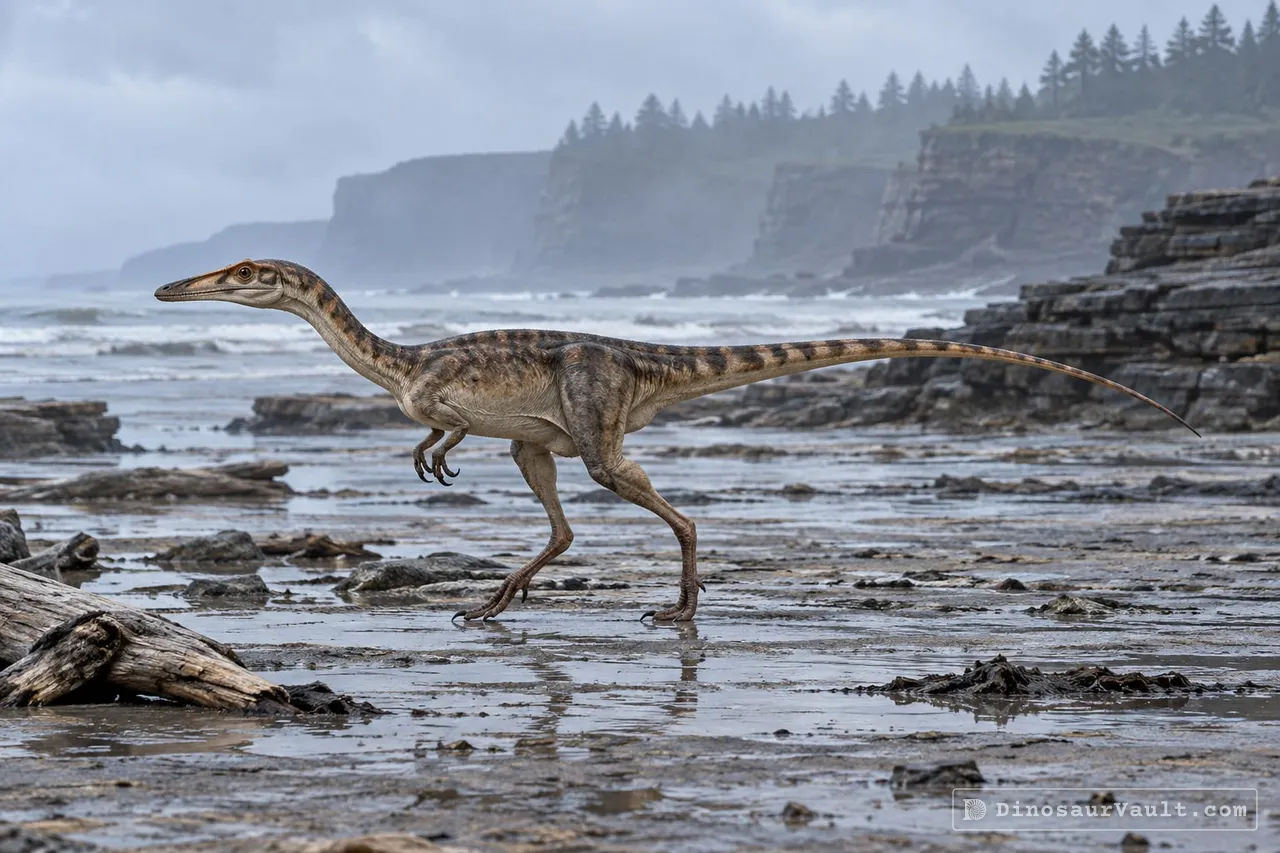
Dracoraptor probably lived on coastal land beside a shallow sea in Wales. Sarcosaurus is another predator known from the Early Jurassic of the United Kingdom.
Field notes
About Dracoraptor
What it was like
Dracoraptor was a small, slender meat eater, about the size of a large dog, related to Coelophysis. It had sharp teeth and walked on two long legs.
Its world
It lived about 201 to 200 million years ago, at the very start of the Early Jurassic, in what is now Wales. Its bones come from the Blue Lias, rocks laid down in a shallow sea near the coast, so its body may have washed out from nearby land.
How it was found
Martill and colleagues named Dracoraptor hanigani in 2016. Two brothers found it on a beach after a cliff fall. It is the first Jurassic dinosaur from Wales and one of the oldest known from the Jurassic.
Field gallery
More views of Dracoraptor
Scenes reconstructed from the available fossil evidence.
Lived alongside
Found in the same rock formations

A rock formation can hold fossils laid down millions of years apart, so not every animal here met Dracoraptor.
The evidence
The science behind Dracoraptor
Which parts of the picture come from its own bones, and which come from its relatives.
From its own fossils
- A partial skeleton includes skull bones, teeth, parts of the backbone, the hips and bones of the arms and legs. A later-recovered left foot was added to the type specimen in a correction.
- Its teeth were curved, flattened from side to side and edged with fine serrations.
- The hand bones include curved claws.
Borrowed from relatives
- Missing parts of the skull roof, lower jaw, neck, shoulders, pelvis and tail are restored by comparison with Tawa.
- Missing hand joints are compared with Tawa and Megapnosaurus; missing toe joints are compared with Dilophosaurus.
Still unknown
- Its full adult size.
- Its skin covering and color.
- Its exact position among the earliest theropod branches.
Discovery timeline
- 2016Named itMartill et al.
- 2016New findMartill et al.
- 2020Family treeEzcurra et al.
- 2021Family treeSpiekman et al.
Key papers
The research behind what we know of Dracoraptor
Named it
Described a partial skeleton of a young meat eater from Wales, with serrated teeth and bones from several parts of its body.
The Oldest Jurassic Dinosaur: A Basal Neotheropod from the Hettangian of Great Britain. PLOS ONE 11: e0145713
Read the paper : The Oldest Jurassic Dinosaur: A Basal Neotheropod from the Hettangian of Great Britain (opens in a new tab)New find
Updated the type specimen record to include a left foot recovered after the original discovery.
Correction: The Oldest Jurassic Dinosaur: A Basal Neotheropod from the Hettangian of Great Britain. PLOS ONE 11: e0154352
Read the paper : Correction: The Oldest Jurassic Dinosaur: A Basal Neotheropod from the Hettangian of Great Britain (opens in a new tab)Family tree
Redescribed Sarcosaurus and compared its bones with Dracoraptor in an analysis of early predator relationships.
A revision of the early neotheropod genusSarcosaurusfrom the Early Jurassic (Hettangian–Sinemurian) of central England. Zoological Journal of the Linnean Society 191: 113-149
Read the paper : A revision of the early neotheropod genusSarcosaurusfrom the Early Jurassic (Hettangian–Sinemurian) of central England (opens in a new tab)Family tree
Compared Pendraig with Dracoraptor and other early predators while testing their relationships in the theropod family tree.
Pendraig milnerae, a new small-sized coelophysoid theropod from the Late Triassic of Wales. Royal Society Open Science 8
Read the paper : Pendraig milnerae, a new small-sized coelophysoid theropod from the Late Triassic of Wales (opens in a new tab)
Close relatives
Other members of Coelophysoidea


Sources: Wikidata