Gojirasaurus
Type species Gojirasaurus quayi
- Lived
- 227 to 206 million years ago, Late Triassic
- Diet
- Carnivore
- Group
- Theropods
- Found in
- United States
- Named by
- Carpenter 1997
Where its fossils were found
The evidence
Today

220 million years ago
Habitat
It probably lived on a river floodplain in what is now New Mexico. Shuvosaurus, a beaked relative of crocodiles, inhabited the region. Pseudopalatus was a long-snouted reptile from the same fossil site.
Field notes
About Gojirasaurus
What it was like
Gojirasaurus was a meat-eating theropod from the very early days of the dinosaurs, when Late Triassic predators tended to be small and lightly built. It appears to have been considerably larger than most other theropods of its time, though it is known from only fragmentary remains, so its full size and appearance are not well established. Its name was inspired by a famous movie monster, chosen to suit an animal of unusual size for its age.
Its world
Gojirasaurus lived in what is now New Mexico, in the southwestern United States, between about 227 and 206 million years ago. This was still early in the age of dinosaurs, when the group had not yet grown into the giants of later periods, and Gojirasaurus shared its world with a range of other early reptiles across the region now called Pangaea.
How it was found
Carpenter named Gojirasaurus in 1997, based on bones recovered from the Bull Canyon Formation. Only one fossil find is known, so many details about how it lived remain unresolved.
Field gallery
More views of Gojirasaurus
Scenes reconstructed from the available fossil evidence.
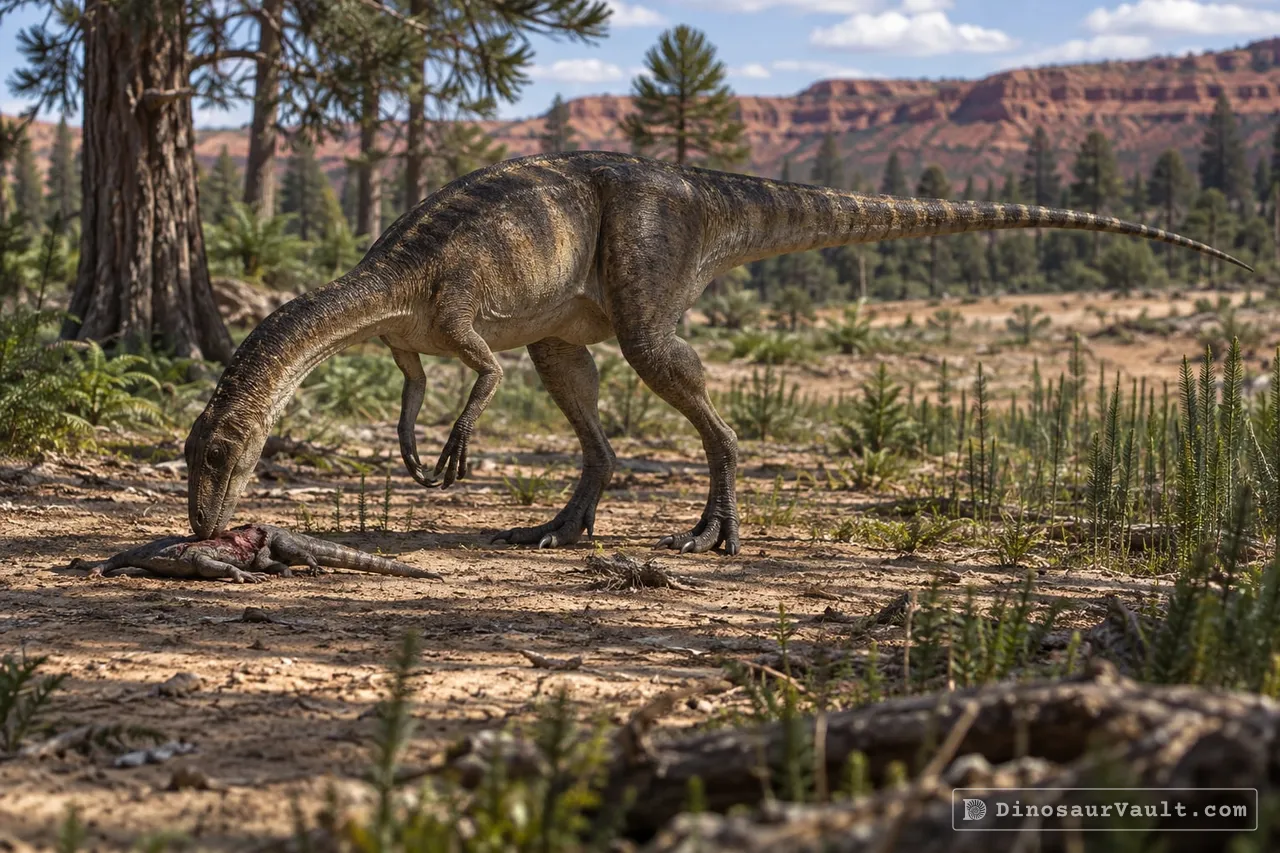
The evidence
The science behind Gojirasaurus
Which parts of the picture come from its own bones, and which come from its relatives.
From its own fossils
- A shinbone and part of the pelvis have features of an early coelophysoid theropod.
- The shinbone is robust compared with those of smaller early theropods.
Borrowed from relatives
- The long neck, slender body and balancing tail are restored from early theropods such as Coelophysis and Liliensternus.
Still unknown
- Which of the bones originally assigned to it belong to the same animal.
- The shape of its skull and its full adult size.
- Its skin covering and color.
Discovery timeline
- 1997Named itCarpenter
- 2007RedescriptionNesbitt, Irmis & Parker
- 2019Growing upGriffin & Nesbitt
Key papers
The research behind what we know of Gojirasaurus
Named it
Named a large early theropod from fragmentary bones in the Bull Canyon Formation.
A Giant Coelophysoid (Ceratosauria) Theropod from the Upper Triassic of New Mexico, USA. Neues Jahrbuch für Geologie und Paläontologie - Abhandlungen 205: 189-208
Read the paper : A Giant Coelophysoid (Ceratosauria) Theropod from the Upper Triassic of New Mexico, USA (opens in a new tab)Redescription
Reassessed the mixed fossil assemblage and restricted the diagnostic theropod material to the shinbone and part of the pelvis.
A critical re‐evaluation of the Late Triassic dinosaur taxa of North America. Journal of Systematic Palaeontology 5: 209-243
Read the paper : A critical re‐evaluation of the Late Triassic dinosaur taxa of North America (opens in a new tab)Growing up
Found signs of immaturity in Gojirasaurus and other large early theropods, suggesting that these animals had more growing to do.
Does the Maximum Body Size of Theropods Increase across the Triassic–Jurassic Boundary? Integrating Ontogeny, Phylogeny, and Body Size. The Anatomical Record 303: 1158-1169
Read the paper : Does the Maximum Body Size of Theropods Increase across the Triassic–Jurassic Boundary? Integrating Ontogeny, Phylogeny, and Body Size (opens in a new tab)
Close relatives
Other members of Coelophysoidea


Sources: Wikidata