Anchisaurus
ANG-kee-SORE-us
"near lizard"
Type species Anchisaurus polyzelus
- Lived
- 201 to 193 million years ago, Early Jurassic
- Length
- about 2 m (7 ft)
- Found in
- United States
- Named by
- Marsh 1885
Size comparison
To scale

Scale in metersOutline: typical early sauropodomorph shape
Where its fossils were found
The evidence
Today

195 million years ago
Habitat
It lived in a rift valley crossed by rivers and occupied by lakes. Its bones occur in the red sandstones of the Portland Formation; Coelophysis is another dinosaur recorded from these rocks.
Field notes
About Anchisaurus
What it was like
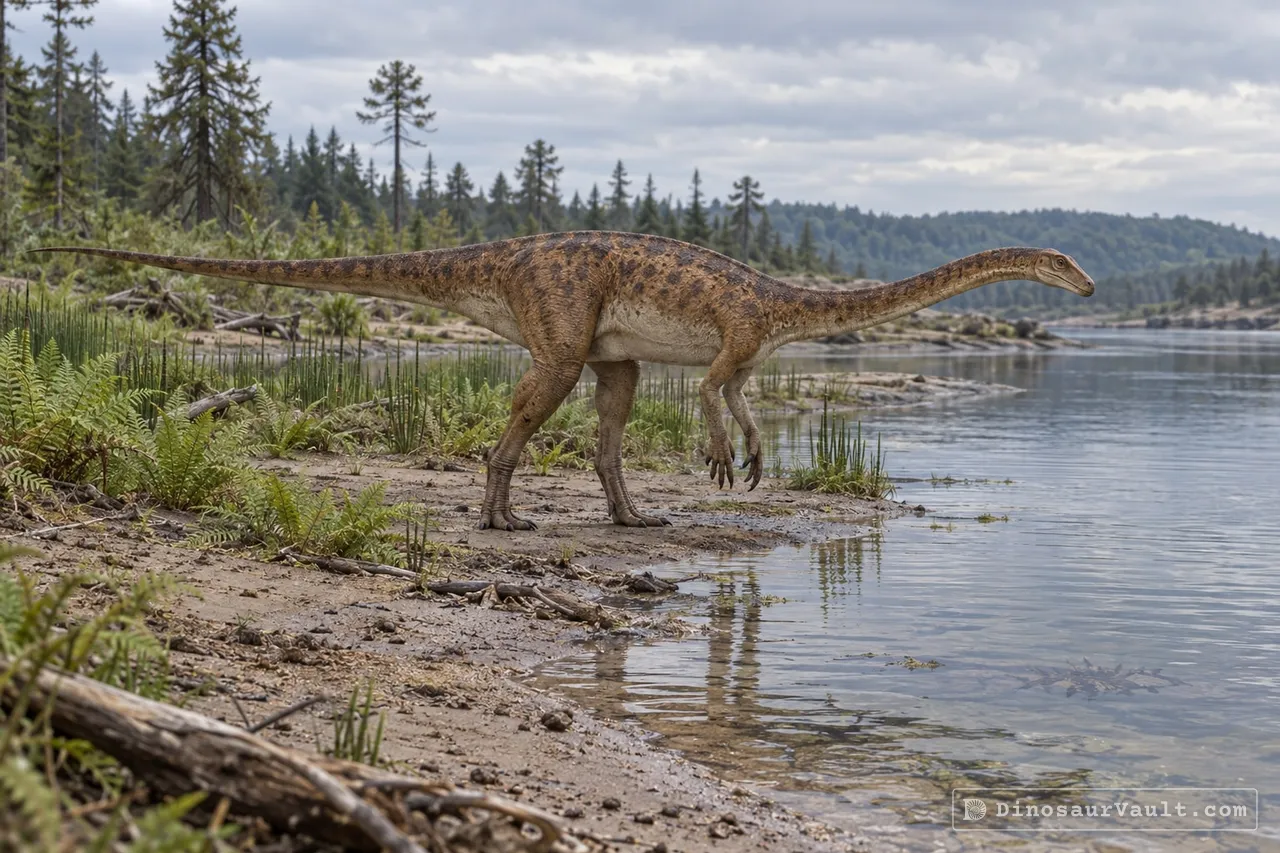
Anchisaurus was a small, lightly built plant eater about 2 meters (7 feet) long. It belonged to the early relatives of the giant sauropods, but it was tiny by comparison, with a long neck, a small head and a long tail. Its hands carried a large thumb claw.
Its world
It lived about 201 to 193 million years ago, in the Early Jurassic, in what is now Connecticut and Massachusetts in the United States. Its bones come from the red sandstones of the Portland Formation, laid down in a rift valley with lakes and rivers.
How it was found
Marsh gave it the name Anchisaurus in 1885, after two earlier names turned out to be taken by other animals. The type species is Anchisaurus polyzelus. Bones of this kind were among the first dinosaur fossils found in North America, dug up long before the word dinosaur existed.
Field gallery
More views of Anchisaurus
Scenes reconstructed from the available fossil evidence.
1 of 3
Lived alongside
Found in the same rock formations

A rock formation can hold fossils laid down millions of years apart, so not every animal here met Anchisaurus.
The evidence
The science behind Anchisaurus
Which parts of the picture come from its own bones, and which come from its relatives.
From its own fossils
- An almost complete skull and skeleton preserve much of its lightly built body.
- Its hands carried a large thumb claw.
- Skull and hip features place it closer to sauropods than to early plant eaters such as Plateosaurus.
Borrowed from relatives
- Most of its skeleton is known directly; missing portions of the neck and tail can be filled in by comparison with other early sauropodomorphs.
Still unknown
- Its color and skin pattern.
- How often it used its forelimbs when moving.
- Which plants it ate.
Discovery timeline
- 1885Named itMarsh
- 1893PostureMarsh
- 2010RedescriptionYATES
Key papers
The research behind what we know of Anchisaurus
Named it
Introduced Anchisaurus as a replacement name because the earlier name was already used for another reptile.
Names of extinct reptiles. American Journal of Science 29: 169
No link available
Posture
Presented an early skeletal reconstruction based on a nearly complete specimen, showing its small head, long neck and lightly built body.
Restoration of Anchisaurus. American Journal of Science s3-45: 169-170
Read the paper : Restoration of Anchisaurus. (opens in a new tab)Redescription
Reexamined skulls and skeletons, united animals previously given separate names and placed Anchisaurus close to the sauropod lineage.
A revision of the problematic sauropodomorph dinosaurs from Manchester, Connecticut and the status of Anchisaurus Marsh. Palaeontology 53: 739-752
Read the paper : A revision of the problematic sauropodomorph dinosaurs from Manchester, Connecticut and the status of Anchisaurus Marsh (opens in a new tab)
Close relatives
Other members of Massopoda


Sources: Wikidata