Matheronodon
"Matheron's tooth"
- Lived
- 84 to 72 million years ago, Late Cretaceous
- Diet
- Herbivore
- Group
- Ornithopods
- Found in
- France
- Named by
- Godefroit et al. 2017
Where its fossils were found
The evidence
Today

80 million years ago
Habitat
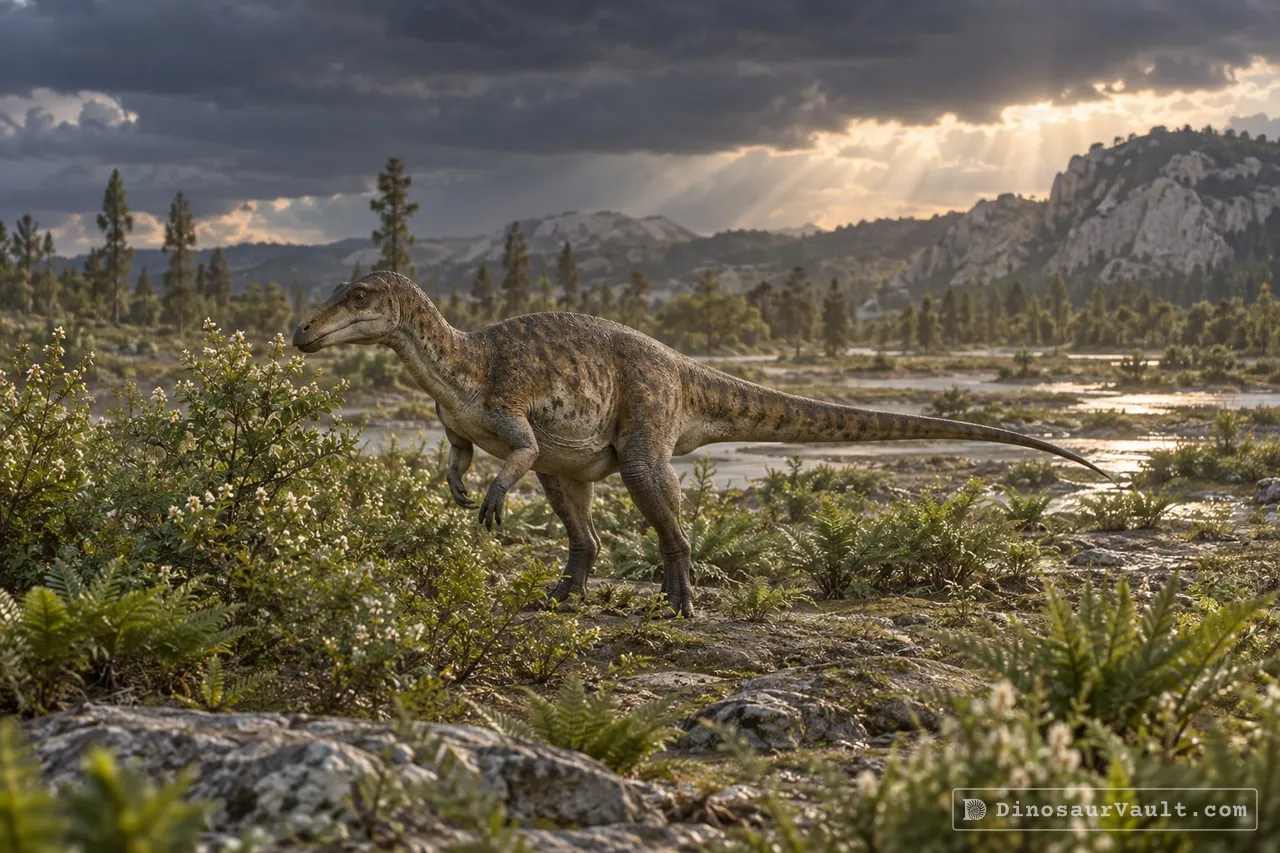
Rivers crossed a broad floodplain with conifers and flowering plants, through alternating dry and wet periods. Its neighbors included Atsinganosaurus, Garrigatitan and turtles.
Field notes
About Matheronodon
What it was like
Matheronodon was a plant eater related to Rhabdodon, known from part of an upper jaw with teeth. Its teeth were very large and few, with sharp ridges, and they seem to have worked like the blades of scissors to slice tough plants.
Its world
It lived in the Late Cretaceous in what is now southern France.
How it was found
Godefroit and colleagues named Matheronodon in 2017, from a single find.
Field gallery
More views of Matheronodon
Scenes reconstructed from the available fossil evidence.
1 of 3
The evidence
The science behind Matheronodon
Which parts of the picture come from its own bones, and which come from its relatives.
From its own fossils
- The type specimen is a robust right upper jaw with a short front process. Separate teeth have been referred to Matheronodon, and none is securely from the same individual.
- Its teeth have unusually broad crowns with many parallel ridges.
- Some neighboring tooth sockets merge into pairs that accommodate the enlarged teeth.
Borrowed from relatives
- Iani, an early relative from North America, provides a broader comparison for the missing skull, neck and upper arm.
Still unknown
- Its body size and proportions, and its exact place among its plant-eating relatives.
- Exactly which plants it ate.
- Its skin covering and color.
Discovery timeline
- 2015Its worldCincotta et al.
- 2017Named itGodefroit et al.
- 2023Family treeAugustin, Ősi & Csiki-Sava
- 2023Family treeZanno et al.
- 2025Family treeCzepiński & Madzia
Key papers
The research behind what we know of Matheronodon
Its world
Reconstructed the rivers, floodplain vegetation and seasonal climate at the fossil site where Matheronodon was found.
Integrated Paleoenvironmental Reconstruction and Taphonomy of a Unique Upper Cretaceous Vertebrate-Bearing Locality (Velaux, Southeastern France). PLOS ONE 10: e0134231
Read the paper : Integrated Paleoenvironmental Reconstruction and Taphonomy of a Unique Upper Cretaceous Vertebrate-Bearing Locality (Velaux, Southeastern France) (opens in a new tab)Named it
Described enlarged teeth and paired tooth sockets, and proposed a powerful cutting bite for slicing tough plants.
Extreme tooth enlargement in a new Late Cretaceous rhabdodontid dinosaur from Southern France. Scientific Reports 7
Read the paper : Extreme tooth enlargement in a new Late Cretaceous rhabdodontid dinosaur from Southern France (opens in a new tab)Family tree
Reviewed Matheronodon and its relatives, including their stocky bodies, strong jaws and adaptations for eating fibrous plants.
The Rhabdodontidae (Dinosauria, Ornithischia), an enigmatic dinosaur group endemic to the Late Cretaceous European Archipelago. Fossil Record 26: 171-189
Read the paper : The Rhabdodontidae (Dinosauria, Ornithischia), an enigmatic dinosaur group endemic to the Late Cretaceous European Archipelago (opens in a new tab)Family tree
Described Iani skull and limb anatomy, providing broader comparisons for missing parts of Matheronodon.
An early-diverging iguanodontian (Dinosauria: Rhabdodontomorpha) from the Late Cretaceous of North America. PLOS ONE 18: e0286042
Read the paper : An early-diverging iguanodontian (Dinosauria: Rhabdodontomorpha) from the Late Cretaceous of North America (opens in a new tab)Family tree
Tested Matheronodon relationships using different character weights and treated it as a probable rhabdodontid whose placement is difficult to resolve.
Exploring the diversity and disparity of rhabdodontomorph ornithopods from the Late Cretaceous European archipelago. Scientific Reports 15
Read the paper : Exploring the diversity and disparity of rhabdodontomorph ornithopods from the Late Cretaceous European archipelago (opens in a new tab)
Close relatives
Other members of Rhabdodontoidea


Sources: Wikidata