Ceratocaudia
"horned tail"
Type species Ceratocaudia antiqua
- Lived
- 193 to 168 million years ago, Early Jurassic to Middle Jurassic
- Diet
- Herbivore
- Group
- Sauropods
- Found in
- India
- Named by
- Natarajan et al. 2026
Where its fossils were found
The evidence
Today

180 million years ago
Habitat
It lived on land in western India, beside a basin that changed between land and shallow sea during the Jurassic.
Field notes
About Ceratocaudia
What it was like
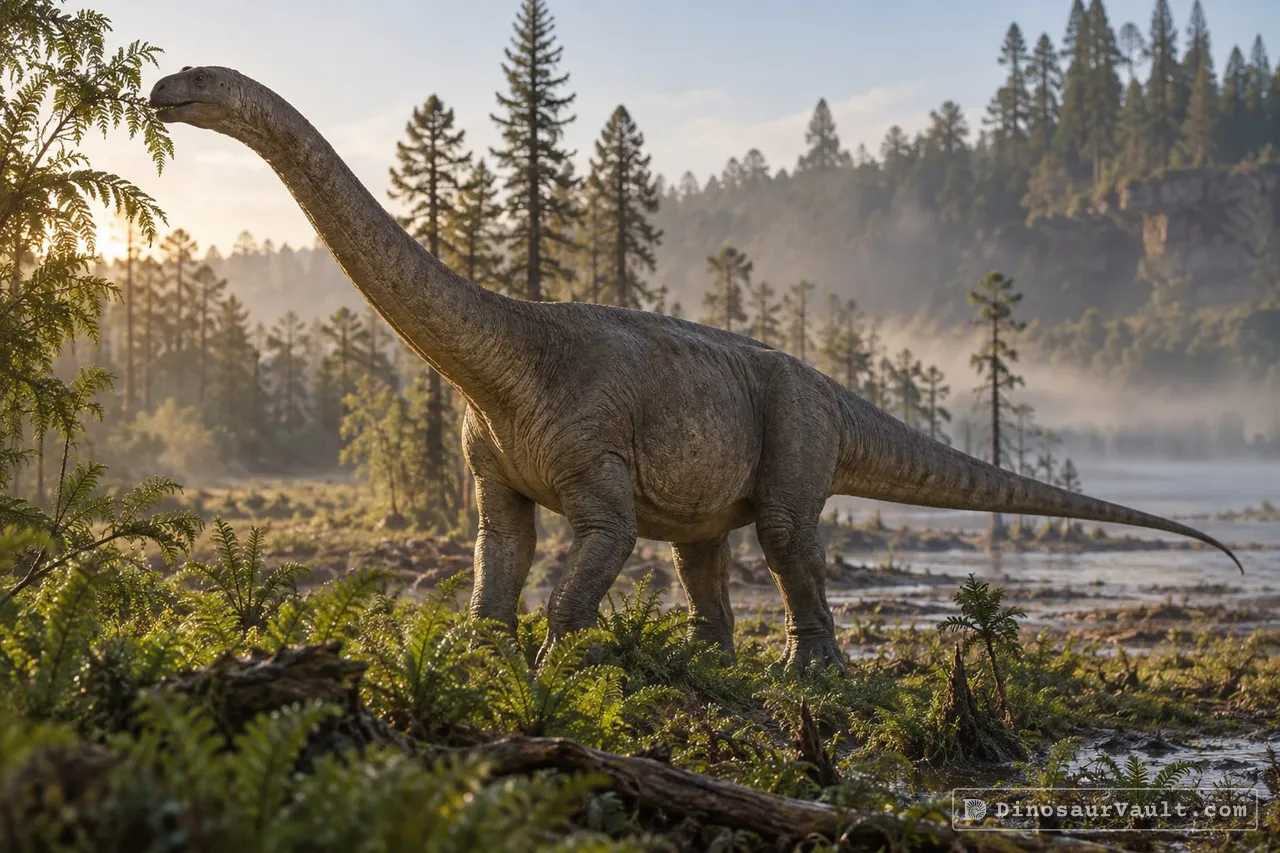
Ceratocaudia was a long-necked sauropod known from a partial skeleton. One vertebra near the base of its tail carries an unusual horn-like crest, which gave it its name. How far that crest stood out in life is unknown.
Its world
It lived in the Jurassic in what is now India. Its bones come from the Kaladongar Formation.
How it was found
Natarajan and colleagues named it in 2026. The type species is Ceratocaudia antiqua.
Field gallery
More views of Ceratocaudia
Scenes reconstructed from the available fossil evidence.
1 of 3
The evidence
The science behind Ceratocaudia
Which parts of the picture come from its own bones, and which come from its relatives.
From its own fossils
- The type is a partial skeleton with neck and tail vertebrae, tail chevrons, an arm bone, three hand bones, the bones of both lower legs, a thigh bone and part of a foot.
- A tail vertebra near the base of the tail carries a horn-like crest, where the straight upper edge of the spine rises abruptly at the back. The tail vertebrae are solid, without air spaces, and their spines are plate-like.
- Microscopic bone structure of the thigh bone, arm bone and a hand bone shows that the animal was old, and the left shin bone is damaged by disease or injury.
Borrowed from relatives
- The missing head is restored by comparison with Europasaurus.
- The neck, body, hands and feet follow Camarasaurus.
Still unknown
- Whether its small adult body resulted from dwarfism.
- Its head, its skin and its colors.
- How far the tail crest stood out in life. Experts have only a tentative model of the tail muscles.
Discovery timeline
- 2022Family treeDai et al.
- 2024Its worldPandey et al.
- 2026Named itNatarajan et al.
Key papers
The research behind what we know of Ceratocaudia
Family tree
Named Yuzhoulong, an early macronarian from China, showing that this sauropod group was already diverse in the Middle Jurassic.
New macronarian from the Middle Jurassic of Chongqing, China: phylogenetic and biogeographic implications for neosauropod dinosaur evolution. Royal Society Open Science 9
Read the paper : New macronarian from the Middle Jurassic of Chongqing, China: phylogenetic and biogeographic implications for neosauropod dinosaur evolution (opens in a new tab)Its world
Reviewed the Jurassic rocks of India, including the basin that preserved Ceratocaudia, and traced changes between land and shallow marine environments.
Marine Jurassic basins along the western and northern margins of the Indian craton: a progress report. Proceedings of the Indian National Science Academy 90: 371-384
Read the paper : Marine Jurassic basins along the western and northern margins of the Indian craton: a progress report (opens in a new tab)Named it
Described a small, old sauropod with unusual neck, tail and leg bones, and placed Ceratocaudia as an early macronarian, outside the titanosauriforms.
A new diminutive Jurassic neosauropod from the Kaladongar Formation (Khadir Uplift) of the Kachchh Basin, western India. Journal of Vertebrate Paleontology 46
Read the paper : A new diminutive Jurassic neosauropod from the Kaladongar Formation (Khadir Uplift) of the Kachchh Basin, western India (opens in a new tab)
Close relatives
Other members of Macronaria


Sources: Wikidata