Chilesaurus
"Chile lizard"
Type species Chilesaurus diegosuarezi
- Lived
- 149 to 143 million years ago, Late Jurassic
- Diet
- Herbivore
- Group
- Early ornithischians
- Found in
- Chile
- Named by
- Novas et al. 2015
Where its fossils were found
The evidence
Today

145 million years ago
Habitat
The Toqui rocks in southern Chile contain Chilesaurus alongside long-necked sauropods and small crocodile-like reptiles.
Field notes
About Chilesaurus
What it was like
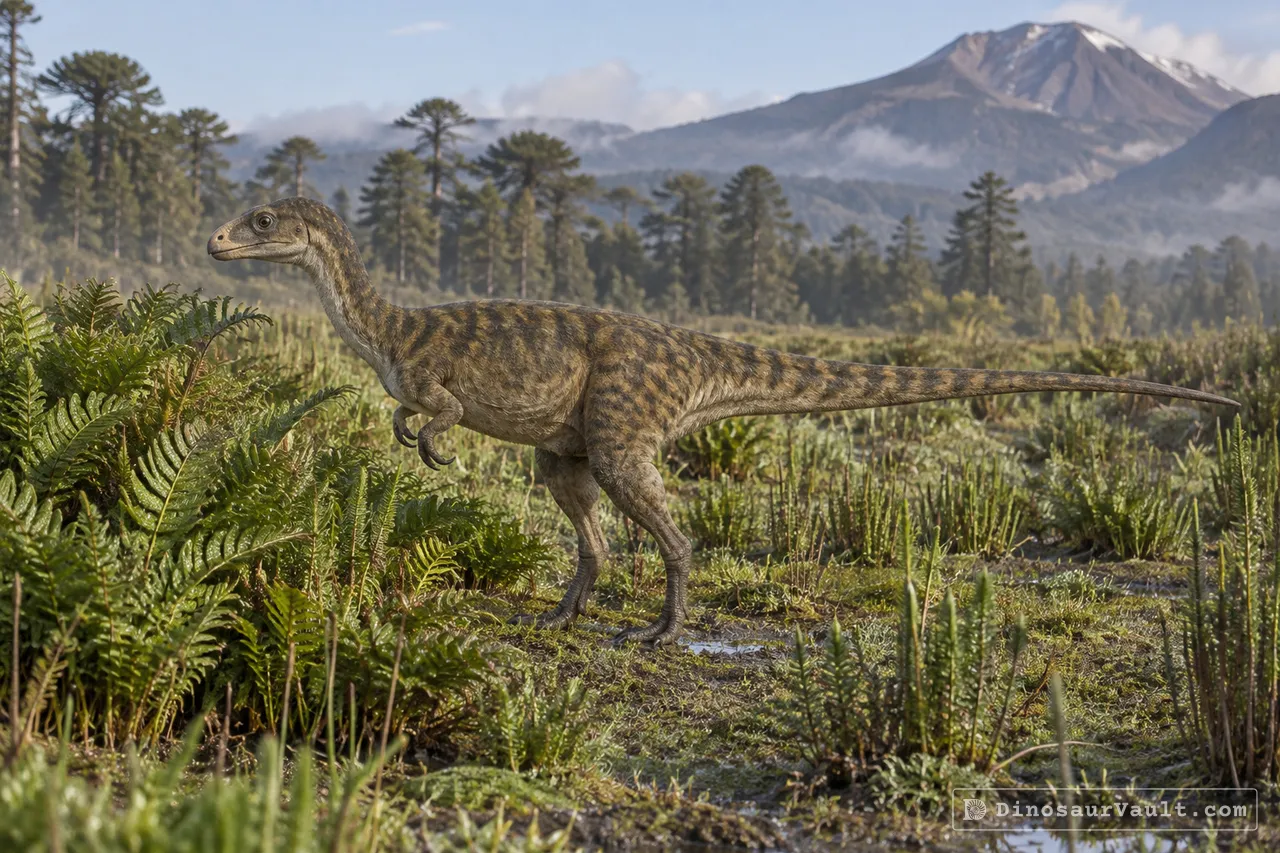
Chilesaurus is one of the strangest dinosaurs ever found. It was a small plant eater with leaf-shaped teeth and a beak, yet it had the body shape of a two-legged predator, with short arms and two fingers on each hand. Its hips look like those of the bird-hipped dinosaurs.
This mix of features makes it hard to place. Many scientists think it was an unusual theropod that turned to eating plants. Others think it sits near the base of the bird-hipped line. The debate is still open.
Its world
It lived in the Late Jurassic in what is now Chile. Its bones come from the Toqui Formation, where many skeletons of it were found together.
How it was found
Novas and colleagues named it in 2015. The type species is Chilesaurus diegosuarezi, which honors the boy who first found its bones.
Field gallery
More views of Chilesaurus
Scenes reconstructed from the available fossil evidence.
1 of 3
The evidence
The science behind Chilesaurus
Which parts of the picture come from its own bones, and which come from its relatives.
From its own fossils
- Several skeletons preserve much of the body, including skull bones and teeth.
- Leaf-shaped teeth and backward-pointing pubic bones are features linked to plant eating.
- Articulated skeletons preserve arms folded tightly, with the hands pointing backward.
Borrowed from relatives
- Much of its skeleton is known directly, so its body shape depends mainly on its own bones.
Still unknown
- Its exact place in the dinosaur family tree.
- Its skin covering and color.
- Which plants it preferred to eat.
Discovery timeline
- 2015Named itNovas et al.
- 2017Family treeBaron & Barrett
- 2017PostureChimento et al.
Key papers
The research behind what we know of Chilesaurus
Named it
Described a plant eater with an unusual mixture of skeletal features and classified it as a theropod.
An enigmatic plant-eating theropod from the Late Jurassic period of Chile. Nature 522: 331-334
Read the paper : An enigmatic plant-eating theropod from the Late Jurassic period of Chile (opens in a new tab)Family tree
Found Chilesaurus near the base of the bird-hipped dinosaurs, offering an alternative to its original theropod classification.
A dinosaur missing-link? Chilesaurus and the early evolution of ornithischian dinosaurs. Biology Letters 13: 20170220
Read the paper : A dinosaur missing-link? Chilesaurus and the early evolution of ornithischian dinosaurs (opens in a new tab)Posture
Studied folded arms in articulated skeletons and proposed that they preserve a resting position.
Forelimb Posture in Chilesaurus diegosuarezi (Dinosauria, Theropoda) and Its Behavioral and Phylogenetic Implications. Ameghiniana 54: 567-575
Read the paper : Forelimb Posture in Chilesaurus diegosuarezi (Dinosauria, Theropoda) and Its Behavioral and Phylogenetic Implications (opens in a new tab)
Close relatives
Other members of Ornithischia


Sources: Wikidata