Tethyshadros
"Tethys hadrosaur"
- Lived
- 84 to 72 million years ago, Late Cretaceous
- Diet
- Herbivore
- Group
- Ornithopods, Telmatosauridae
- Found in
- Italy
- Named by
- Dalla Vecchia 2009
Where its fossils were found
The evidence
Today

80 million years ago
Habitat
It lived on land beside shallow coastal waters in the Tethys region of what is now Italy. The surrounding waters held fish, crustaceans and small crocodile relatives.
Field notes
About Tethyshadros
What it was like
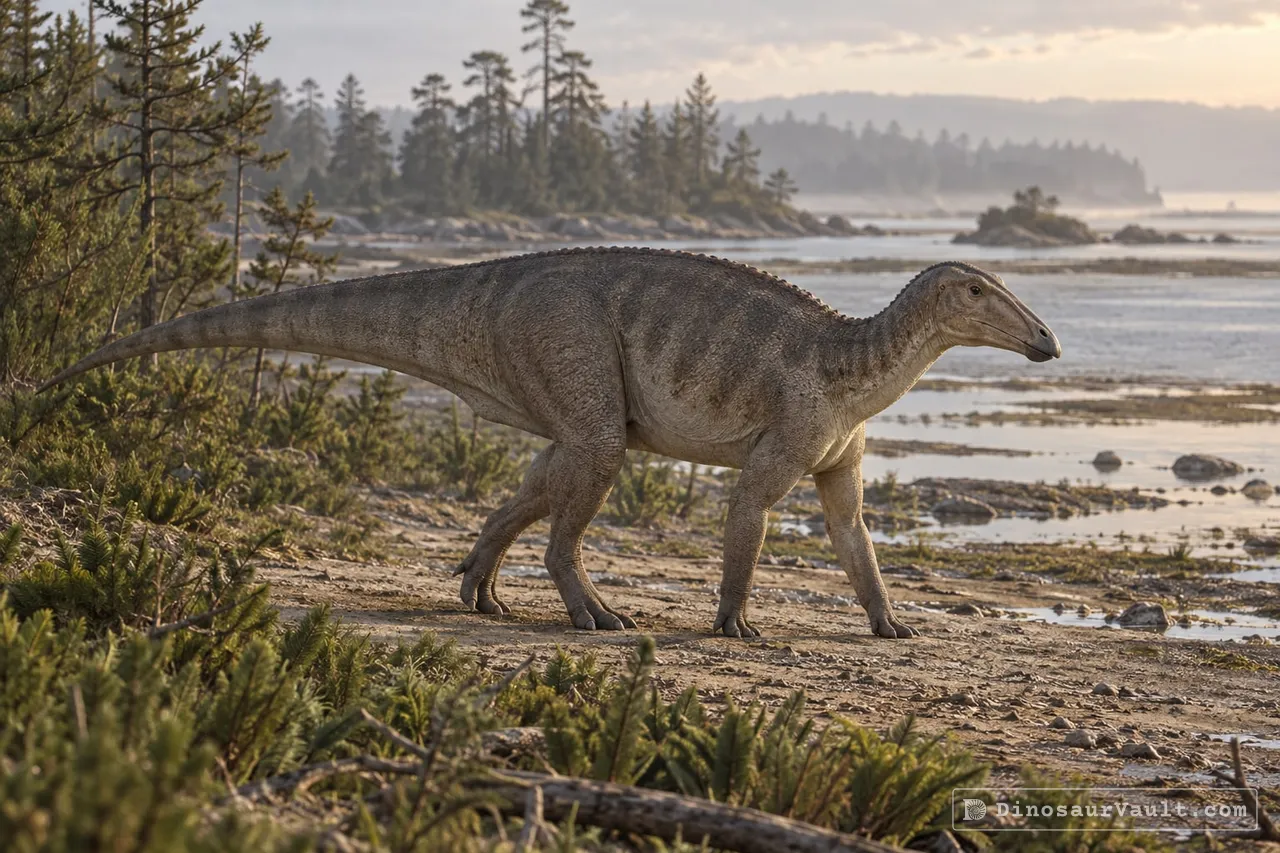
Tethyshadros was a small relative of the duckbills, about the size of a pony. It had a long, narrow beak, long legs and fewer fingers than most relatives. Its small size may come from life on an island.
Its world
It lived in the Late Cretaceous, in what is now Italy. At the time the region was an island in the Tethys, a warm sea between Africa and Europe.
How it was found
Dalla Vecchia named Tethyshadros in 2009, from a nearly complete skeleton found in a limestone quarry. It is one of the most complete dinosaurs ever found in Italy.
Field gallery
More views of Tethyshadros
Scenes reconstructed from the available fossil evidence.
1 of 3
The evidence
The science behind Tethyshadros
Which parts of the picture come from its own bones, and which come from its relatives.
From its own fossils
- A nearly complete skeleton preserves the skull, backbone and limbs.
- A larger skeleton has a shorter, sturdier skull than the first specimen.
Borrowed from relatives
- Almost the whole skeleton is known from its own fossils, so its body proportions need little borrowing from relatives.
- Tail muscles are restored by comparing its vertebrae with other duckbill relatives and living crocodiles.
Still unknown
- Its skin color and markings.
- Whether island life affected its size.
- How it nested and cared for its young.
Discovery timeline
- 2009Named itDalla Vecchia
- 2021Growing upChiarenza et al.
Key papers
The research behind what we know of Tethyshadros
Named it
Described a nearly complete skeleton of a duckbill relative from Italy and proposed that its small size reflected island life.
Tethyshadros insularis , a new hadrosauroid dinosaur (Ornithischia) from the Upper Cretaceous of Italy. Journal of Vertebrate Paleontology 29: 1100-1116
Read the paper : Tethyshadros insularis , a new hadrosauroid dinosaur (Ornithischia) from the Upper Cretaceous of Italy (opens in a new tab)Growing up
A larger skeleton and bone tissue showed that the first specimen was still growing, challenging the idea that Tethyshadros was an island dwarf.
An Italian dinosaur Lagerstätte reveals the tempo and mode of hadrosauriform body size evolution. Scientific Reports 11
Read the paper : An Italian dinosaur Lagerstätte reveals the tempo and mode of hadrosauriform body size evolution (opens in a new tab)
Close relatives
Other members of Telmatosauridae


Sources: Wikidata