Ambopteryx
"both wings"
- Lived
- 162 to 143 million years ago, Late Jurassic
- Diet
- Carnivore
- Group
- Theropods, Scansoriopterygidae
- Found in
- China
- Named by
- Wang et al. 2019
Where its fossils were found
The evidence
Today

150 million years ago
Habitat
Forests in northeastern China included conifers, ginkgo relatives and cycads. Yi and Anchiornis also belonged to the region's Jurassic fauna.
Field notes
About Ambopteryx
What it was like
Ambopteryx was a tiny, tree-dwelling dinosaur with wings made of skin instead of feathers. A long, rod-like bone at each wrist helped hold up a membrane, like that of a bat, and it also had feathers on its body.
It is a close relative of Yi, the first dinosaur found with this kind of wing. It probably glided between trees rather than flew with flapping wings.
Its world
It lived in the Late Jurassic in what is now northeastern China.
How it was found
Wang and colleagues named Ambopteryx in 2019, from a single skeleton. Its fossil also held pebbles in its stomach, and the remains of its last meal, which suggest it ate both plants and small animals.
Field gallery
More views of Ambopteryx
Scenes reconstructed from the available fossil evidence.
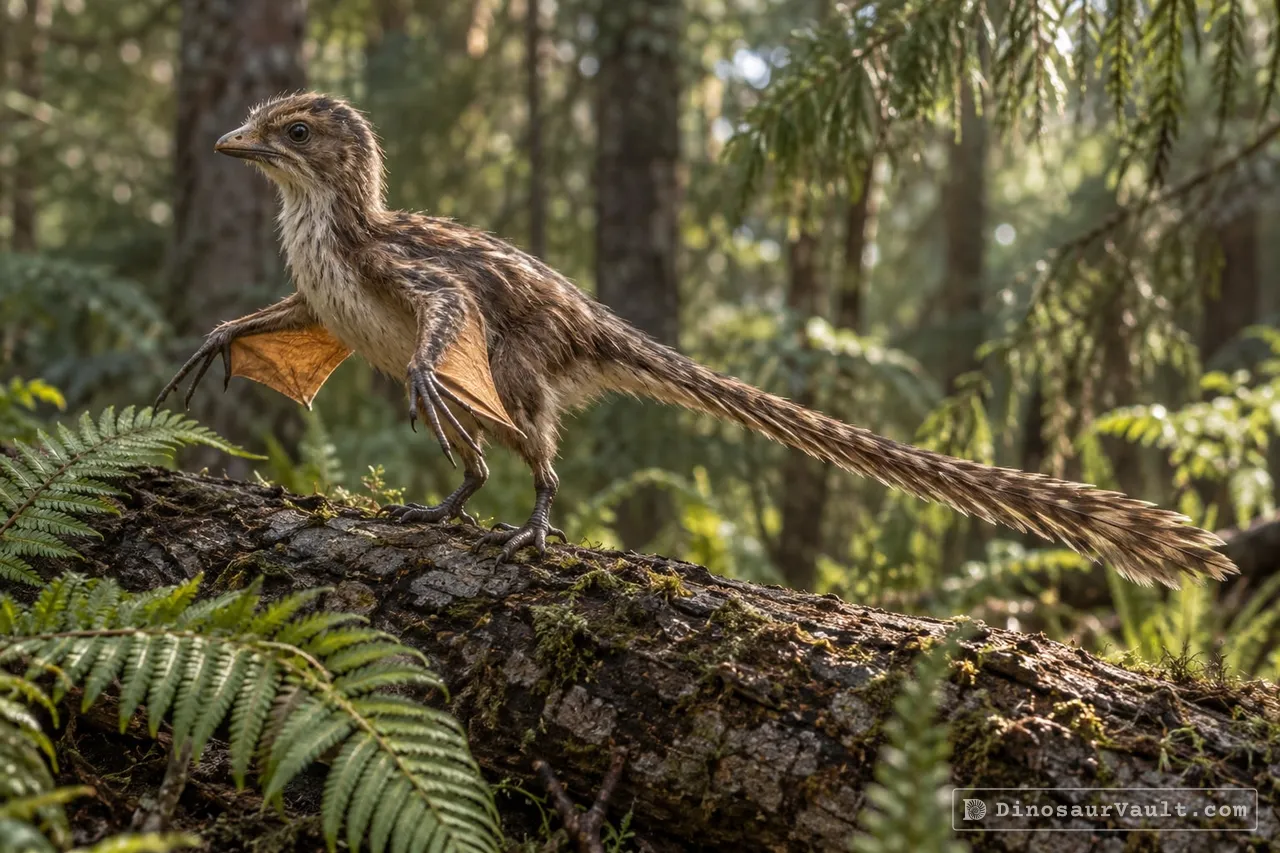
The evidence
The science behind Ambopteryx
Which parts of the picture come from its own bones, and which come from its relatives.
From its own fossils
- A nearly complete skeleton preserves long arms, an extra rod-like support at the wrist and patches of wing membrane.
- Feathers covered the body alongside the skin wings.
- Small stones and bony fragments lie in the stomach region.
Borrowed from relatives
- Much of its body is known from its own skeleton; Yi helps guide how the wing membrane is restored around the fingers and wrist support.
Still unknown
- The full outline of its spread wings.
- Its color.
- How much of its diet came from plants.
Discovery timeline
- 2015Close relativeXu et al.
- 2019Named itWang et al.
- 2019How it fedO'Connor & Zhou
- 2020PostureDececchi et al.
Key papers
The research behind what we know of Ambopteryx
Close relative
Described Yi, whose wrist rods and preserved membranes provide a comparison for restoring the wings of Ambopteryx.
A bizarre Jurassic maniraptoran theropod with preserved evidence of membranous wings. Nature 521: 70-73
Read the paper : A bizarre Jurassic maniraptoran theropod with preserved evidence of membranous wings (opens in a new tab)Named it
Described a feathered dinosaur with skin wings and a rod-like wrist support, confirming that this wing design occurred beyond Yi.
A new Jurassic scansoriopterygid and the loss of membranous wings in theropod dinosaurs. Nature 569: 256-259
Read the paper : A new Jurassic scansoriopterygid and the loss of membranous wings in theropod dinosaurs (opens in a new tab)How it fed
Reviewed fossil meals and stomach stones; the bony stomach contents of Ambopteryx suggest that it ate animals as well as possibly plants.
The evolution of the modern avian digestive system: insights from paravian fossils from the Yanliao and Jehol biotas. Palaeontology 63: 13-27
Read the paper : The evolution of the modern avian digestive system: insights from paravian fossils from the Yanliao and Jehol biotas (opens in a new tab)Posture
Flight models suggest that Ambopteryx and Yi could glide only poorly and were unlikely to fly by flapping.
Aerodynamics Show Membrane-Winged Theropods Were a Poor Gliding Dead-end. iScience 23: 101574
Read the paper : Aerodynamics Show Membrane-Winged Theropods Were a Poor Gliding Dead-end (opens in a new tab)
Close relatives
Other members of Scansoriopterygidae


Sources: Wikidata