Migmanychion
"mixed claw"
Type species Migmanychion laiyang
- Lived
- 121 to 120 million years ago, Early Cretaceous
- Diet
- Carnivore
- Group
- Theropods
- Found in
- China
- Named by
- Wang et al. 2023
Where its fossils were found
The evidence
Today

120 million years ago
Habitat
It lived in what is now northeastern China, where the Longjiang Formation also preserves the feathered Daurlong.
Field notes
About Migmanychion
What it was like
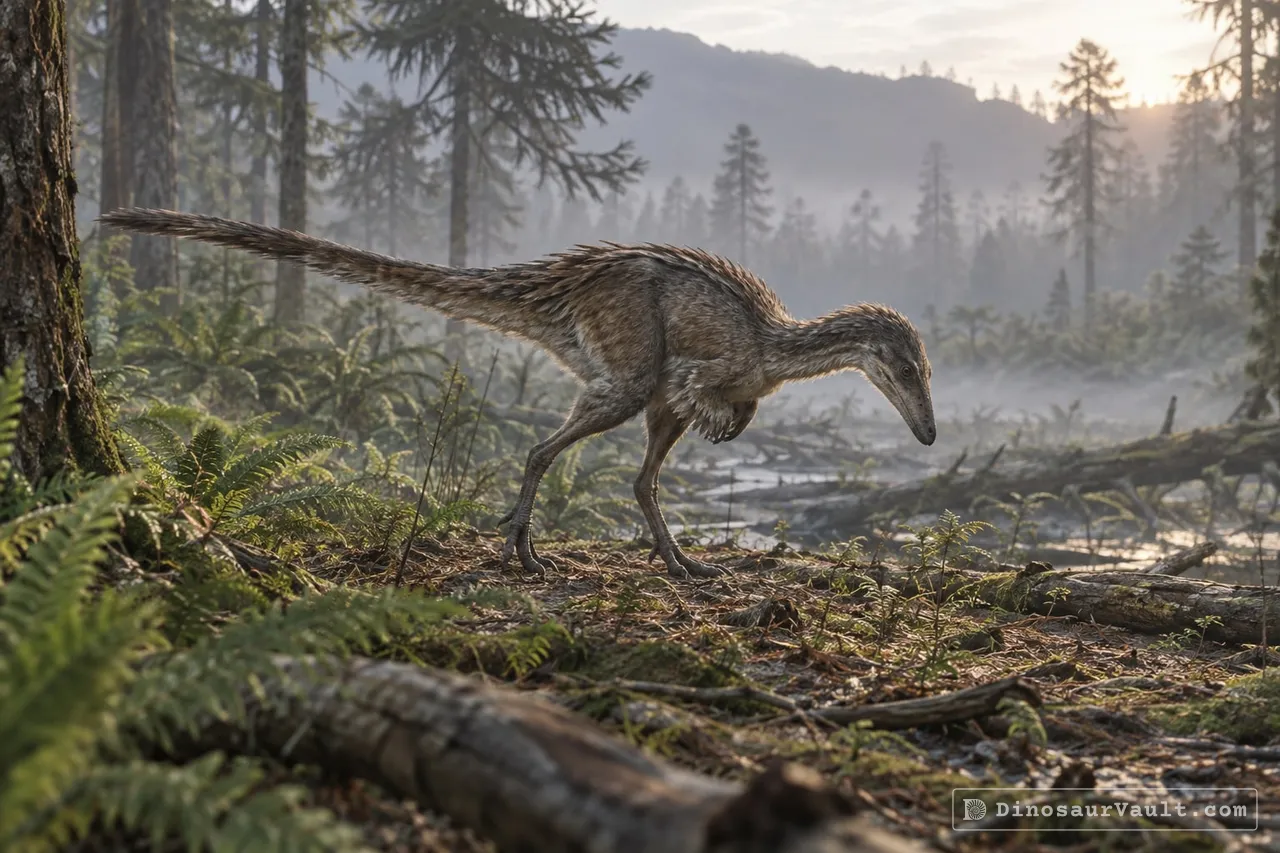
Migmanychion was a small feathered theropod known from part of a front leg. Its arm shows a mix of features seen in different groups of bird-like dinosaurs.
Its world
It lived in the Early Cretaceous in what is now northeastern China. Its bones come from the Longjiang Formation, where the small feathered Daurlong also lived.
How it was found
Wang and colleagues named it in 2023. The type species is Migmanychion laiyang.
Field gallery
More views of Migmanychion
Scenes reconstructed from the available fossil evidence.
Lived alongside
Found in the same rock formations

A rock formation can hold fossils laid down millions of years apart, so not every animal here met Migmanychion.
The evidence
The science behind Migmanychion
Which parts of the picture come from its own bones, and which come from its relatives.
From its own fossils
- Its known bones come mainly from an incomplete left arm with a complete hand.
- Its hand combines features found in therizinosaurs, oviraptorosaurs and Fukuivenator.
Borrowed from relatives
- The missing head, trunk and legs are reconstructed by comparison with bird-like theropods such as Fukuivenator.
- A feathered covering is inferred from relatives such as Daurlong.
Still unknown
- Its exact place among bird-like theropods.
- The shape of its skull and teeth.
- Its feather pattern and color.
Discovery timeline
- 2016Close relativeAzuma et al.
- 2022Same rocksWang et al.
- 2023Named itWang et al.
Key papers
The research behind what we know of Migmanychion
Close relative
Described the nearly complete Fukuivenator, whose unusual mix of features provides a comparison for the fragmentary Migmanychion.
A bizarre theropod from the Early Cretaceous of Japan highlighting mosaic evolution among coelurosaurians. Scientific Reports 6
Read the paper : A bizarre theropod from the Early Cretaceous of Japan highlighting mosaic evolution among coelurosaurians (opens in a new tab)Same rocks
Described Daurlong from the Longjiang Formation, including feather remains and preserved traces of its intestine.
Intestinal preservation in a birdlike dinosaur supports conservatism in digestive canal evolution among theropods. Scientific Reports 12
Read the paper : Intestinal preservation in a birdlike dinosaur supports conservatism in digestive canal evolution among theropods (opens in a new tab)Named it
Named a small theropod from forelimb bones and found that its unusual hand most closely resembled that of Fukuivenator.
A new theropod dinosaur from the Lower Cretaceous Longjiang Formation of Inner Mongolia (China). Cretaceous Research 151: 105605
Read the paper : A new theropod dinosaur from the Lower Cretaceous Longjiang Formation of Inner Mongolia (China) (opens in a new tab)
Close relatives
Other members of Maniraptora

Sources: Wikidata