Craspedodon
"edge tooth"
Type species Craspedodon lonzeensis
- Lived
- 90 to 84 million years ago, Late Cretaceous
- Diet
- Herbivore
- Group
- Ornithopods
- Found in
- Belgium
- Named by
- Dollo 1883
Where its fossils were found
The evidence
Today

90 million years ago
Habitat
Its teeth come from rocks laid down in a shallow sea in what is now Belgium.
Field notes
About Craspedodon
What it was like
Craspedodon is known from a few teeth. They came from a plant eater, and some scientists have suggested it was a ceratopsian rather than an ornithopod.
Its world
It lived in the Late Cretaceous, in what is now Belgium. It comes from the Glauconie de Lonzée, rocks laid down in a shallow sea.
How it was found
Dollo named Craspedodon in 1883. The type species is Craspedodon lonzeensis.
Field gallery
More views of Craspedodon
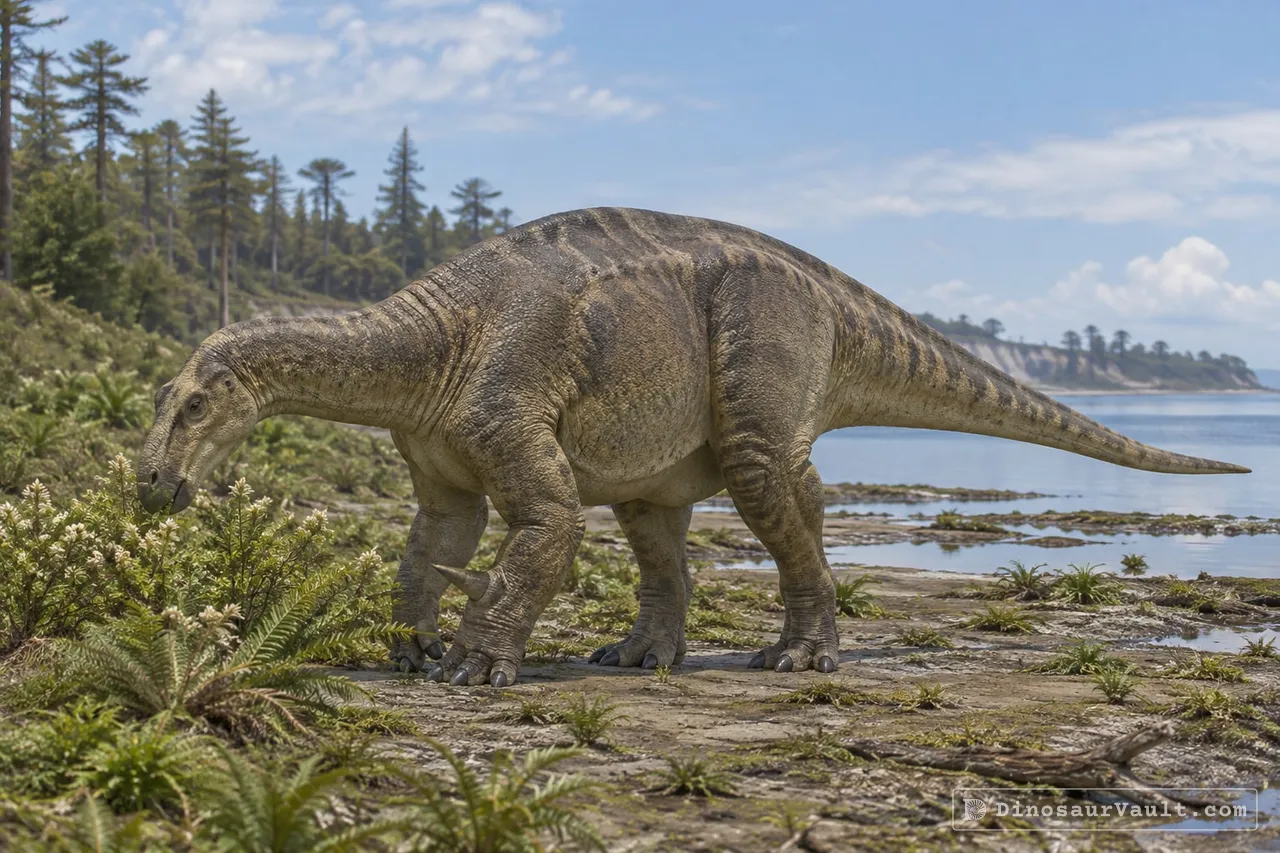
Scenes reconstructed from the available fossil evidence.
The evidence
The science behind Craspedodon
Which parts of the picture come from its own bones, and which come from its relatives.
From its own fossils
- A few isolated teeth with strong ridges and deep pockets on their crowns.
- The teeth have enamel concentrated on one side of the crown.
Borrowed from relatives
- Its teeth resemble those of Protoceratops and Turanoceratops; a ceratopsian restoration borrows the body from those relatives.
Still unknown
- Whether it was a ceratopsian or an ornithopod.
- Its body shape and size.
- Whether its teeth are distinctive enough to identify a separate genus.
Discovery timeline
- 1883Named itDollo
- 2010Family treeŐsi, Butler & Weishampel
- 2026Family treeMaidment et al.
Key papers
The research behind what we know of Craspedodon
Named it
Named Craspedodon from isolated plant-eater teeth found in Belgium.
Note sur les restes de dinosauriens rencontrés dans le Crétacé supérieur de la Belgique [Note on the dinosaur remains found in the Upper Cretaceous of Belgium]. Bulletin du Musée Royal d'Histoire Naturelle de Belgique 2: 205-221
No link available
Family tree
Described Ajkaceratops, strengthening the case that ceratopsians lived in Europe, where Craspedodon had been a disputed record.
A Late Cretaceous ceratopsian dinosaur from Europe with Asian affinities. Nature 465: 466-468
Read the paper : A Late Cretaceous ceratopsian dinosaur from Europe with Asian affinities (opens in a new tab)Family tree
New Ajkaceratops material supports ceratopsian ancestry and reveals that some European plant eaters previously classed as ornithopods were ceratopsians.
A hidden diversity of ceratopsian dinosaurs in Late Cretaceous Europe. Nature 651: 397-403
Read the paper : A hidden diversity of ceratopsian dinosaurs in Late Cretaceous Europe (opens in a new tab)
Close relatives
Other members of Iguanodontoidea

Sources: Wikidata