Bayannurosaurus
"Bayannur lizard"
- Lived
- 121 to 120 million years ago, Early Cretaceous
- Diet
- Herbivore
- Group
- Ornithopods
- Found in
- China
- Named by
- Xu et al. 2018
Where its fossils were found
The evidence
Today

120 million years ago
Habitat
It lived in a lake basin in northern China. Mayflies, aquatic beetles and small clam shrimps lived in the waters of the same formation.
Field notes
About Bayannurosaurus
What it was like
Bayannurosaurus was a large plant eater related to Iguanodon. It is known from a nearly complete skeleton.
Its world
It lived in the Early Cretaceous in what is now northern China. Its bones come from the Bayingebi Formation.
How it was found
Xu and colleagues named it in 2018. It is named after the city region where it was found.
Field gallery
More views of Bayannurosaurus
Scenes reconstructed from the available fossil evidence.
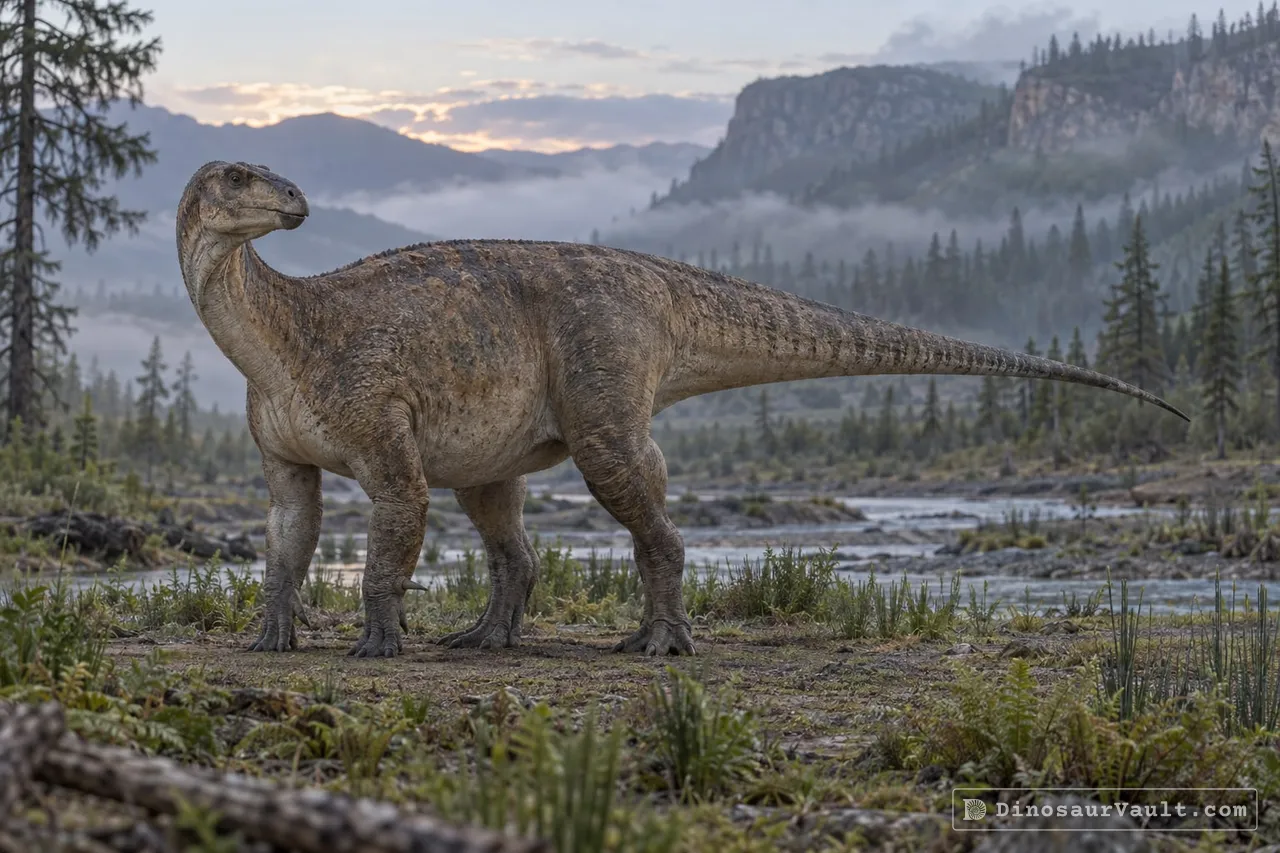
1 of 3
The evidence
The science behind Bayannurosaurus
Which parts of the picture come from its own bones, and which come from its relatives.
From its own fossils
- A nearly complete skeleton preserves the skull, limbs and almost the whole tail.
- The bones at the tip of its tail are fused together.
- Its limb proportions suggest that it usually walked on all fours.
Borrowed from relatives
- Almost the whole body is known from its own skeleton; comparisons with Iguanodon and Ouranosaurus help explain its posture.
Still unknown
- Its skin color and pattern.
- How its body proportions changed as it grew.
- Whether it lived in herds.
Discovery timeline
- 2016Same rocksLi et al.
- 2018Named itXu et al.
- 2021Family treeLockwood, Martill & Maidment
Key papers
The research behind what we know of Bayannurosaurus
Same rocks
Found fossil mayflies, aquatic beetles and clam shrimps in the same formation as Bayannurosaurus.
Discovery of the Jehol Biota from the Celaomiao region and discussion of the Lower Cretaceous of the Bayingebi Basin, northwestern China. Palaeoworld 25: 76-83
Read the paper : Discovery of the Jehol Biota from the Celaomiao region and discussion of the Lower Cretaceous of the Bayingebi Basin, northwestern China (opens in a new tab)Named it
Described a nearly complete skeleton with fused tail-tip bones and limb proportions suggesting that it usually walked on all fours.
A large-sized basal ankylopollexian from East Asia, shedding light on early biogeographic history of Iguanodontia. Science Bulletin 63: 556-563
Read the paper : A large-sized basal ankylopollexian from East Asia, shedding light on early biogeographic history of Iguanodontia (opens in a new tab)Family tree
An expanded family-tree analysis changed the placement of Bayannurosaurus among the relatives of duckbilled dinosaurs.
A new hadrosauriform dinosaur from the Wessex Formation, Wealden Group (Early Cretaceous), of the Isle of Wight, southern England. Journal of Systematic Palaeontology 19: 847-888
Read the paper : A new hadrosauriform dinosaur from the Wessex Formation, Wealden Group (Early Cretaceous), of the Isle of Wight, southern England (opens in a new tab)
Close relatives
Other members of Ankylopollexia


Sources: Wikidata