Sciurumimus
"squirrel mimic"
Type species Sciurumimus albersdoerferi
- Lived
- 152 to 149 million years ago, Late Jurassic
- Diet
- Carnivore
- Group
- Theropods
- Found in
- Germany
- Named by
- Rauhut et al. 2012
Where its fossils were found
The evidence
Today

150 million years ago
Habitat
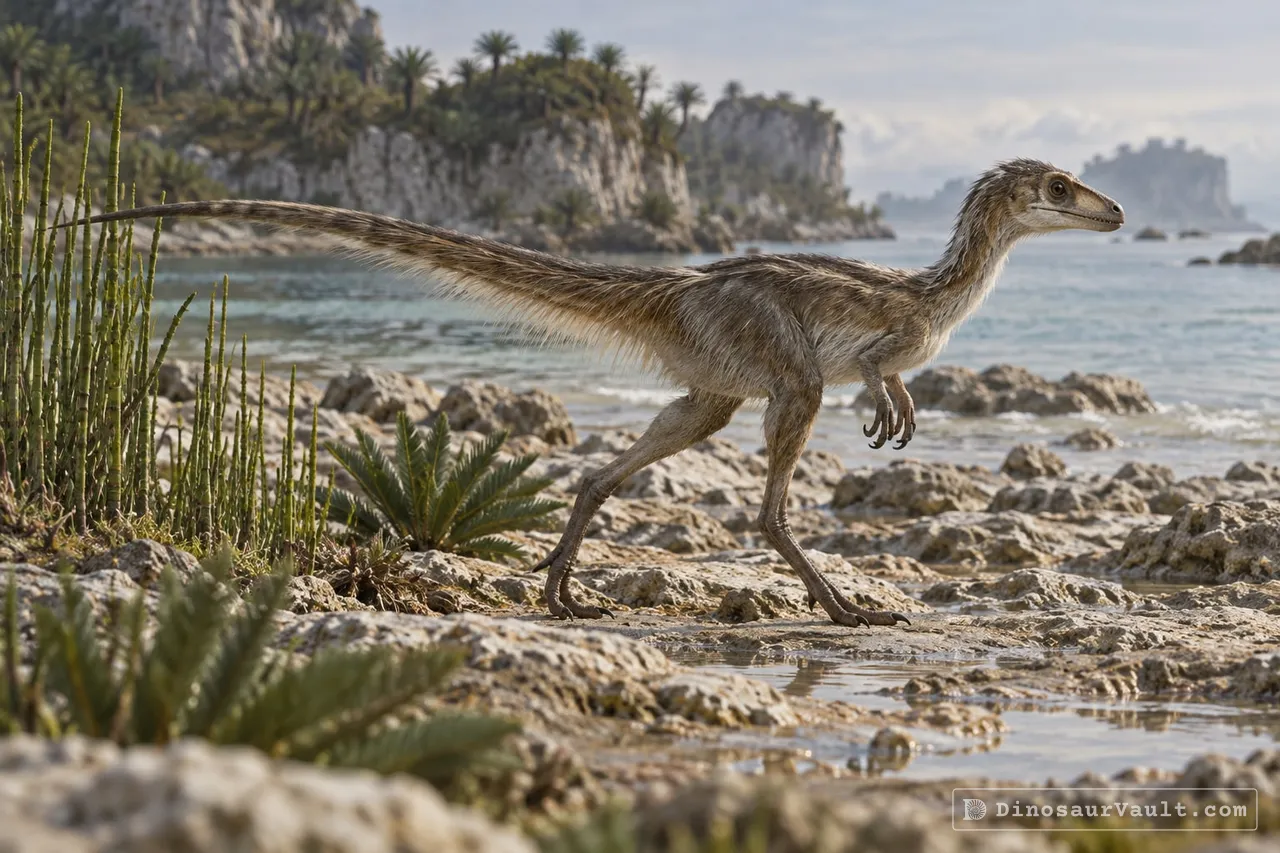
Islands bordered by quiet marine waters, with vegetation probably including low, bushy conifers. Archaeopteryx and Juravenator also lived in this island region.
Field notes
About Sciurumimus
What it was like
Sciurumimus is known from one beautiful skeleton of a baby meat eater, only a few weeks or months old when it died. Its big eyes and short snout are typical of young animals.
The fossil shows traces of fine, hair-like fuzz on its body and tail. Its bushy tail reminded the scientists of a squirrel's, which gave it its name. It helps show that simple feathers may have covered many kinds of theropods, not just the ones closest to birds.
Its world
It lived about 152 to 149 million years ago, in the Late Jurassic, in what is now southern Germany. Its fossil comes from fine limestone of the Torleite Formation, laid down in quiet water near islands.
How it was found
Rauhut and colleagues named Sciurumimus albersdoerferi in 2012. Because the skeleton is so young, scientists still debate which family of theropods it belongs to.
Field gallery
More views of Sciurumimus
Scenes reconstructed from the available fossil evidence.
1 of 3
The evidence
The science behind Sciurumimus
Which parts of the picture come from its own bones, and which come from its relatives.
From its own fossils
- A complete young skeleton preserves the skull, limbs and long tail together on a limestone slab.
- Fine, hair-like feathers are preserved on the body and around the base of the tail.
Borrowed from relatives
- Almost the whole young animal is known from its own bones.
- An adult restoration draws on larger theropods such as Megalosaurus, following studies that place Sciurumimus among megalosauroids.
Still unknown
- Its adult size and body proportions.
- Its exact place in the theropod family tree.
- Its color and whether its feather covering changed as it grew.
Discovery timeline
- 2012Named itRauhut et al.
- 2020SkinFoth et al.
Key papers
The research behind what we know of Sciurumimus
Named it
Described a young skeleton with fine feathers and proposed that Sciurumimus belonged to the megalosauroid branch of theropods.
Exceptionally preserved juvenile megalosauroid theropod dinosaur with filamentous integument from the Late Jurassic of Germany. Proceedings of the National Academy of Sciences 109: 11746-11751
Read the paper : Exceptionally preserved juvenile megalosauroid theropod dinosaur with filamentous integument from the Late Jurassic of Germany (opens in a new tab)Skin
Compared feather traces under different light wavelengths and identified a crest of filaments along the upper edge of the tail base.
Two of a Feather: A Comparison of the Preserved Integument in the Juvenile Theropod Dinosaurs Sciurumimus and Juravenator from the Kimmeridgian Torleite Formation of Southern Germany. Fascinating Life Sciences: 79-101
Read the paper : Two of a Feather: A Comparison of the Preserved Integument in the Juvenile Theropod Dinosaurs Sciurumimus and Juravenator from the Kimmeridgian Torleite Formation of Southern Germany (opens in a new tab)
Sources: Wikidata