Scelidosaurus
"limb lizard"
- Lived
- 200 to 184 million years ago, Early Jurassic
- Diet
- Herbivore
- Length
- about 4 m (13 ft)
- Group
- Early armored dinosaurs, Scelidosauridae
- Found in
- United Kingdom
- Named by
- Owen 1859
Size comparison
To scale

Scale in meters
Where its fossils were found
The evidence
Today

190 million years ago
Also reported from China.
Habitat
Scelidosaurus probably lived on land near the coast of what is now England. Its skeletons were buried in marine mud after the bodies were likely carried out to sea.
Field notes
About Scelidosaurus
What it was like
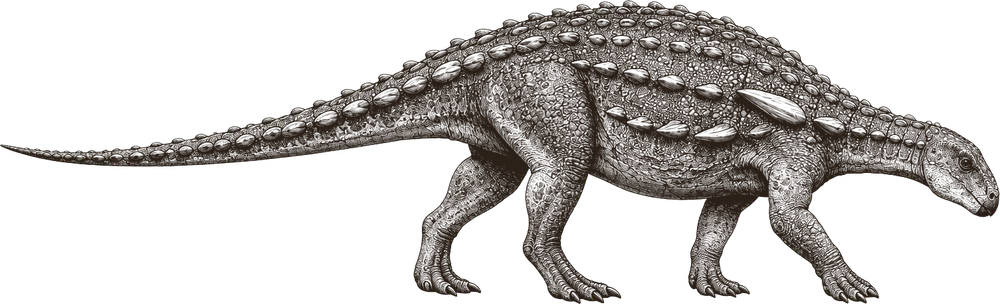
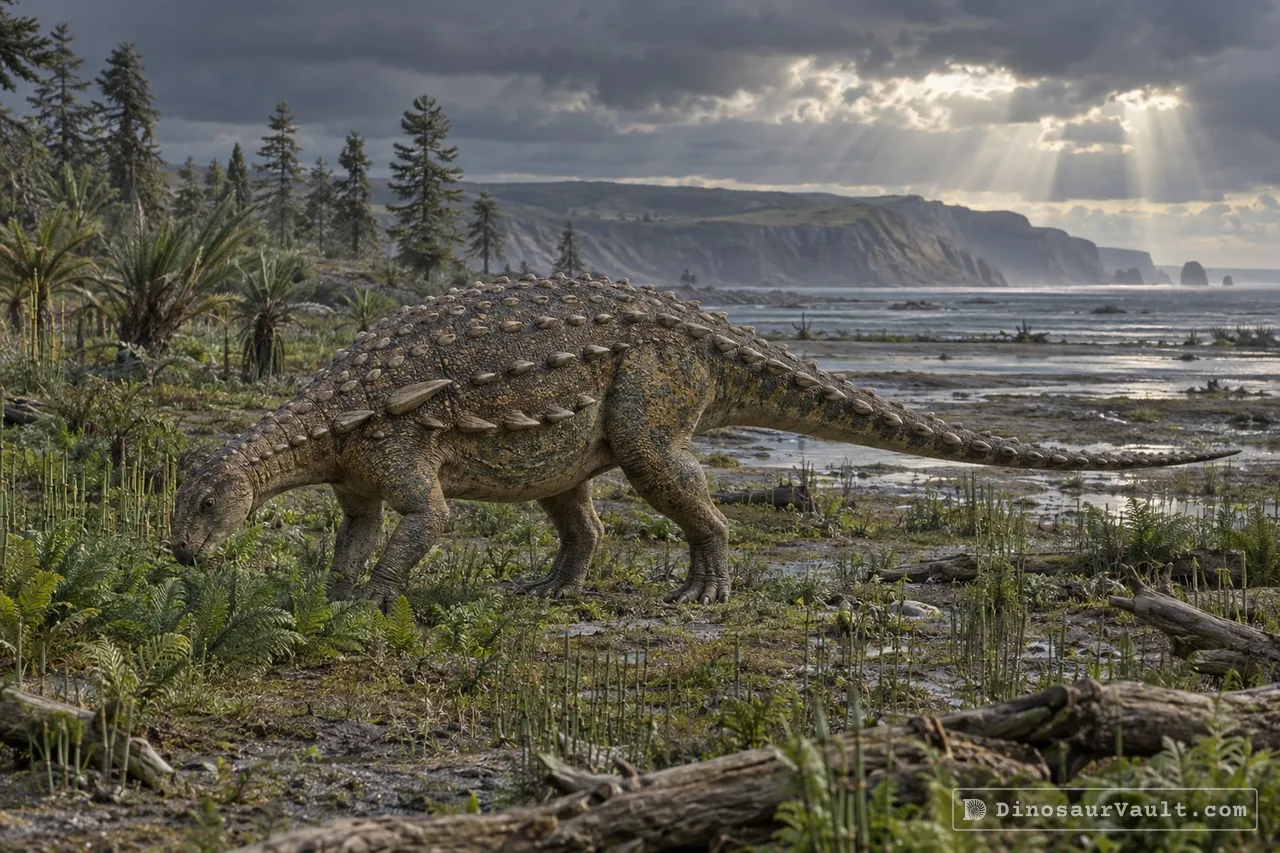
Scelidosaurus was a heavily built, plant-eating dinosaur that walked on four sturdy legs. Rows of bony studs, called scutes, ran in long lines along its neck, back, and tail, giving it light but effective body armor, even though it lacked the heavy clubs and spikes seen in later armored dinosaurs. It had a small head with a horny beak at the front of the jaws, used to crop low-growing plants that were then broken down in a large gut. Scelidosaurus grew to about 4 meters (13 feet) long.
Its world
Scelidosaurus lived from about 200 to 184 million years ago, during the Early Jurassic, in what is now the United Kingdom. Its fossils come from the Charmouth Mudstone Formation on the English coast, and related remains have also been reported from China.
How it was found
Owen named Scelidosaurus in 1859, based on some of the earliest good dinosaur fossils ever found in the United Kingdom. Eleven fossil finds are known today, including skeletons preserved in remarkable detail, which makes Scelidosaurus one of the best-known early armored dinosaurs despite its age. Even so, its exact place in the dinosaur family tree has been debated for a long time, with some researchers linking it closely to the ankylosaurs and others to the stegosaurs.
Field gallery
More views of Scelidosaurus
Scenes reconstructed from the available fossil evidence.
1 of 7
The evidence
The science behind Scelidosaurus
Which parts of the picture come from its own bones, and which come from its relatives.
From its own fossils
- Well-preserved skeletons reveal a small head, sturdy limbs and a long tail.
- Rows of bony armor ran along the back and flanks.
- Preserved skin includes small scales between larger armored structures.
Borrowed from relatives
- Almost the whole body is known from its own bones, so little skeletal anatomy needs to be borrowed from relatives.
Still unknown
- The color of its skin and armor.
- Whether adults cared for their young.
- Exactly which plants grew on the nearby land.
Often drawn wrong
- It had neither an ankylosaur tail club nor tall stegosaur plates.
- Its armor formed lengthwise rows rather than the broad transverse bands seen in later ankylosaurs.
Discovery timeline
- 1859Named itOwen
- 2019SkullNorman
- 2019Full descriptionNorman
- 2020SkinNorman
- 2020Family treeNorman
Key papers
The research behind what we know of Scelidosaurus
Named it
Introduced the name for an early armored dinosaur from England.
Palaeontology. The Encyclopaedia Brittanica, or Dictionary of Arts, Sciences, and General Literature (8th Edition) 17: 91-176
No link available
Skull
Redescribed the skull and jaws in detail, documenting the teeth and the bony structures around the eyes.
Scelidosaurus harrisonii from the Early Jurassic of Dorset, England: cranial anatomy. Zoological Journal of the Linnean Society 188: 1-81
Read the paper : Scelidosaurus harrisonii from the Early Jurassic of Dorset, England: cranial anatomy (opens in a new tab)Full description
Described the backbone, limbs and other bones behind the skull using the original skeleton and additional specimens.
Scelidosaurus harrisonii from the Early Jurassic of Dorset, England: postcranial skeleton. Zoological Journal of the Linnean Society 189: 47-157
Read the paper : Scelidosaurus harrisonii from the Early Jurassic of Dorset, England: postcranial skeleton (opens in a new tab)Skin
Mapped the armor and preserved skin, and compared how these structures developed in smaller and larger animals.
Scelidosaurus harrisoniifrom the Early Jurassic of Dorset, England: the dermal skeleton. Zoological Journal of the Linnean Society 190: 1-53
Read the paper : Scelidosaurus harrisoniifrom the Early Jurassic of Dorset, England: the dermal skeleton (opens in a new tab)Family tree
Examined movement, feeding and breathing, and proposed a close relationship with ankylosaurs.
Scelidosaurus harrisonii(Dinosauria: Ornithischia) from the Early Jurassic of Dorset, England: biology and phylogenetic relationships. Zoological Journal of the Linnean Society 191: 1-86
Read the paper : Scelidosaurus harrisonii(Dinosauria: Ornithischia) from the Early Jurassic of Dorset, England: biology and phylogenetic relationships (opens in a new tab)
Close relatives
Other members of Scelidosauridae

Sources: Wikidata