Ostromia
- Lived
- Late Jurassic
- Diet
- Carnivore
- Group
- Theropods, Anchiornithidae
- Named by
- Foth and Rauhut 2017
Where its fossils were found
The evidence
Fossil record
Jachenhausen, Painten Basin, Germany
Late Jurassic
The incomplete specimen was named as a separate genus in a published reassessment. A later study questions that distinction and favors its placement with a better-known early bird genus. Its classification remains disputed.
No finds with map coordinates are recorded yet.
Habitat
It lived near islands and coastal land beside shallow seas in Late Jurassic Germany. The region also supported Compsognathus, Juravenator and Sciurumimus.
Field notes
About Ostromia
What it was like
Ostromia is a name given to a small feathered theropod known from an incomplete skeleton. Its original description placed it close to Anchiornis, but its identity remains disputed.
How it was found
Foth and Rauhut named Ostromia in 2017 after reexamining a fossil previously assigned to a better-known early bird genus. A later study questioned whether it belongs to a separate genus. The name honors the paleontologist who first recognized that the fossil was not a flying reptile, as once thought.
Field gallery
More views of Ostromia
Scenes reconstructed from the available fossil evidence.
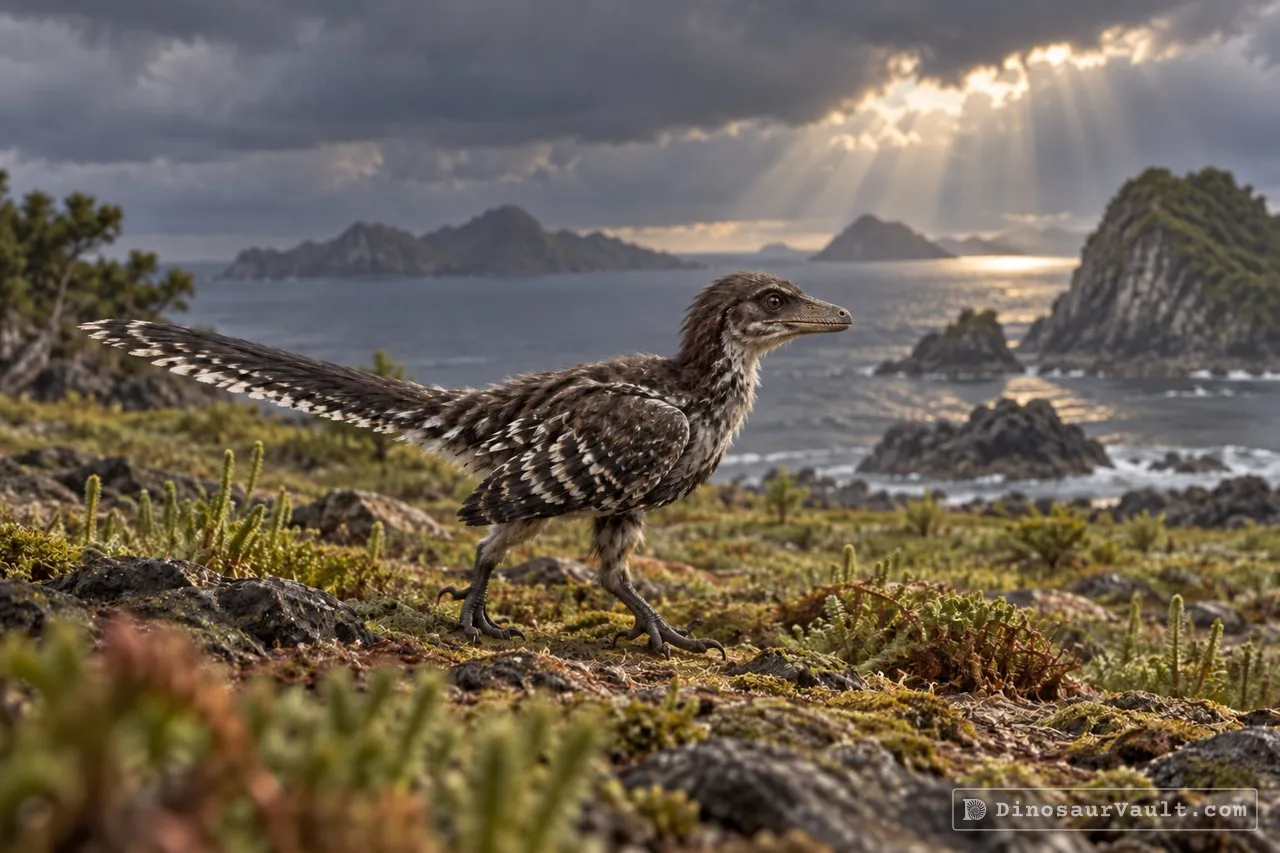
The evidence
The science behind Ostromia
Which parts of the picture come from its own bones, and which come from its relatives.
From its own fossils
- The partial skeleton preserves parts of the hands, legs and pelvis.
- Its finger bones carry regular grooves along their length.
- The preserved pelvic bone curves forward, resembling that of Anchiornis.
Borrowed from relatives
- The missing head and much of the body are restored by comparison with Anchiornis.
- Long feathers on the arms and legs follow the plumage preserved in Anchiornis.
Still unknown
- Its full feather pattern and color.
- Whether it could fly.
- Its exact position among the earliest relatives of birds.
Discovery timeline
- 2009Close relativeHu et al.
- 2010Close relativeLi et al.
- 2017Named itFoth & Rauhut
Key papers
The research behind what we know of Ostromia
Close relative
Described an Anchiornis skeleton with long feathers on the arms, legs and feet, a guide to restoring its relatives.
A pre-Archaeopteryx troodontid theropod from China with long feathers on the metatarsus. Nature 461: 640-643
Read the paper : A pre-Archaeopteryx troodontid theropod from China with long feathers on the metatarsus (opens in a new tab)Close relative
Reconstructed an Anchiornis feather-color pattern from preserved pigment structures; the result belongs to that relative rather than Ostromia itself.
Plumage Color Patterns of an Extinct Dinosaur. Science 327: 1369-1372
Read the paper : Plumage Color Patterns of an Extinct Dinosaur (opens in a new tab)Named it
Reassigned a partial skeleton previously identified as an early bird and recognized it as a relative of Anchiornis.
Re-evaluation of the Haarlem Archaeopteryx and the radiation of maniraptoran theropod dinosaurs. BMC Evolutionary Biology 17
Read the paper : Re-evaluation of the Haarlem Archaeopteryx and the radiation of maniraptoran theropod dinosaurs (opens in a new tab)
Sources: Wikidata