Gyposaurus
"vulture lizard"
Type species Gyposaurus capensis
- Lived
- Early Jurassic
- Diet
- Herbivore
- Group
- Early sauropodomorphs, Anchisauridae
- Named by
- Broom 1911
Where its fossils were found
The evidence
Fossil record
Ladybrand, South Africa, Clarens Formation
Early Jurassic
The name-bearing South African skeleton has an imprecise original locality. Historical Chinese referrals are withheld after the type specimens were reassigned; the identity of other referred specimens remains unresolved.
No finds with map coordinates are recorded yet.
Habitat
The name-bearing skeleton was reported from rocks near Ladybrand in South Africa, assigned to the Clarens Formation in a later review. Its exact original locality is uncertain.
Field notes
About Gyposaurus
What it was like
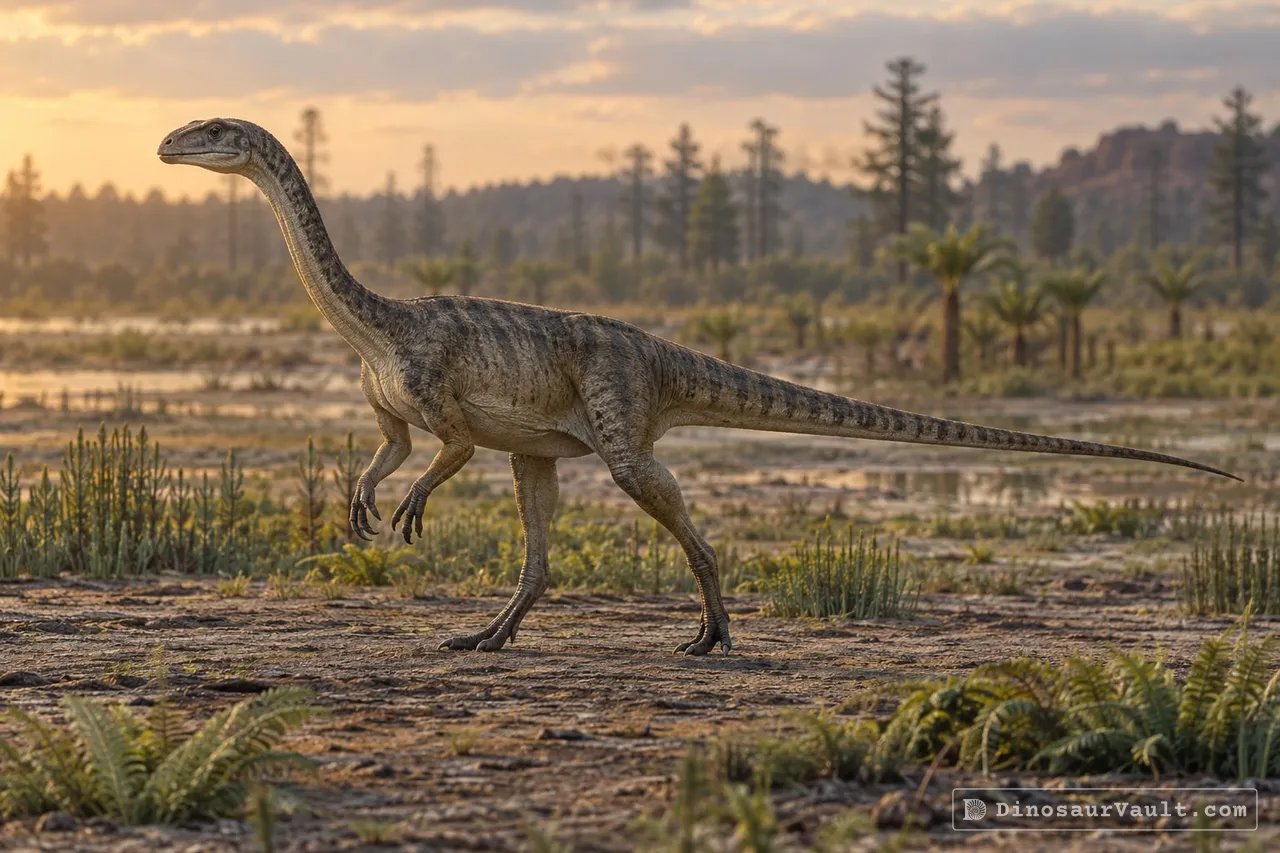
Gyposaurus was a small plant eater from the long-necked line that later produced the giant sauropods. Its name, "vulture lizard," comes from an old idea that these animals ate meat.
The name was first applied to a partial skeleton from South Africa. Its status is disputed, and the skeleton may belong to another named sauropodomorph.
Its world
The name-bearing skeleton comes from Early Jurassic rocks near Ladybrand in South Africa. Its exact original locality is uncertain.
How it was found
Broom named Gyposaurus in 1911. A second species was later named from China, but a detailed reassessment identified its type skeletons as immature animals of another genus. Those historical referrals do not establish a Chinese range for the South African name.
Field gallery
More views of Gyposaurus
Scenes reconstructed from the available fossil evidence.
The evidence
The science behind Gyposaurus
Which parts of the picture come from its own bones, and which come from its relatives.
From its own fossils
- The name-bearing South African specimen is a partial skeleton without a skull, preserved partly as natural molds.
- The Chinese type skeletons historically assigned to the name were still growing and have been reassigned to another genus.
Borrowed from relatives
- The South African skeleton has been compared with other early sauropodomorphs, but its identity remains disputed.
Still unknown
- The identity of the South African name-bearing skeleton and of every later Chinese specimen assigned to Gyposaurus.
- The skin color of the animals given this name.
Discovery timeline
- 1911Named itBroom
- 1941New findYOUNG
- 2024RedescriptionWang, Zhao & You
Key papers
The research behind what we know of Gyposaurus
Named it
Introduced Gyposaurus for fossils from South Africa.
On the dinosaurs of the Stormberg, South Africa. Annals of the South African Museum 7: 291-308
No link available
New find
Described the Chinese species sinensis, placing its skeletons in the genus Gyposaurus.
Gyposaurus sinensis Young (sp. nov.) a New Prosauropoda from the Upper Triassic Beds at Lufeng, Yunnan*. Bulletin of the Geological Society of China 21: 205-252
Read the paper : Gyposaurus sinensis Young (sp. nov.) a New Prosauropoda from the Upper Triassic Beds at Lufeng, Yunnan* (opens in a new tab)Redescription
Restudied the surviving Chinese type skeletons and identified them as immature Lufengosaurus rather than a separate species.
Reassessment of ‘Gyposaurus’ sinensis Young, 1941 (Dinosauria: Sauropodomorpha) from the Early Jurassic Lufeng Basin, Yunnan Province, China. Zoological Journal of the Linnean Society 203
Read the paper : Reassessment of ‘Gyposaurus’ sinensis Young, 1941 (Dinosauria: Sauropodomorpha) from the Early Jurassic Lufeng Basin, Yunnan Province, China (opens in a new tab)
Close relatives
Other members of Anchisauridae

Sources: Wikidata