Actiosaurus
"coast lizard"
Type species Actiosaurus gaudryi
- Lived
- 206 to 201 million years ago, Late Triassic
- Diet
- Herbivore
- Group
- Early sauropodomorphs, Anchisauridae
- Found in
- France
- Named by
- Sauvage 1883
Where its fossils were found
The evidence
Today

200 million years ago
Habitat
Its bones come from Late Triassic deposits in France, where marine reptiles and fishes were also buried.
Field notes
About Actiosaurus
What it was like
Actiosaurus is known from a few limb bones. It was once thought to be an early dinosaur, but later studies suggest the bones belong to a marine reptile instead, so it may not be a dinosaur at all.
Its world
It lived at the end of the Triassic in what is now France.
How it was found
Sauvage named Actiosaurus in 1883. The type species is Actiosaurus gaudryi.
Field gallery
More views of Actiosaurus
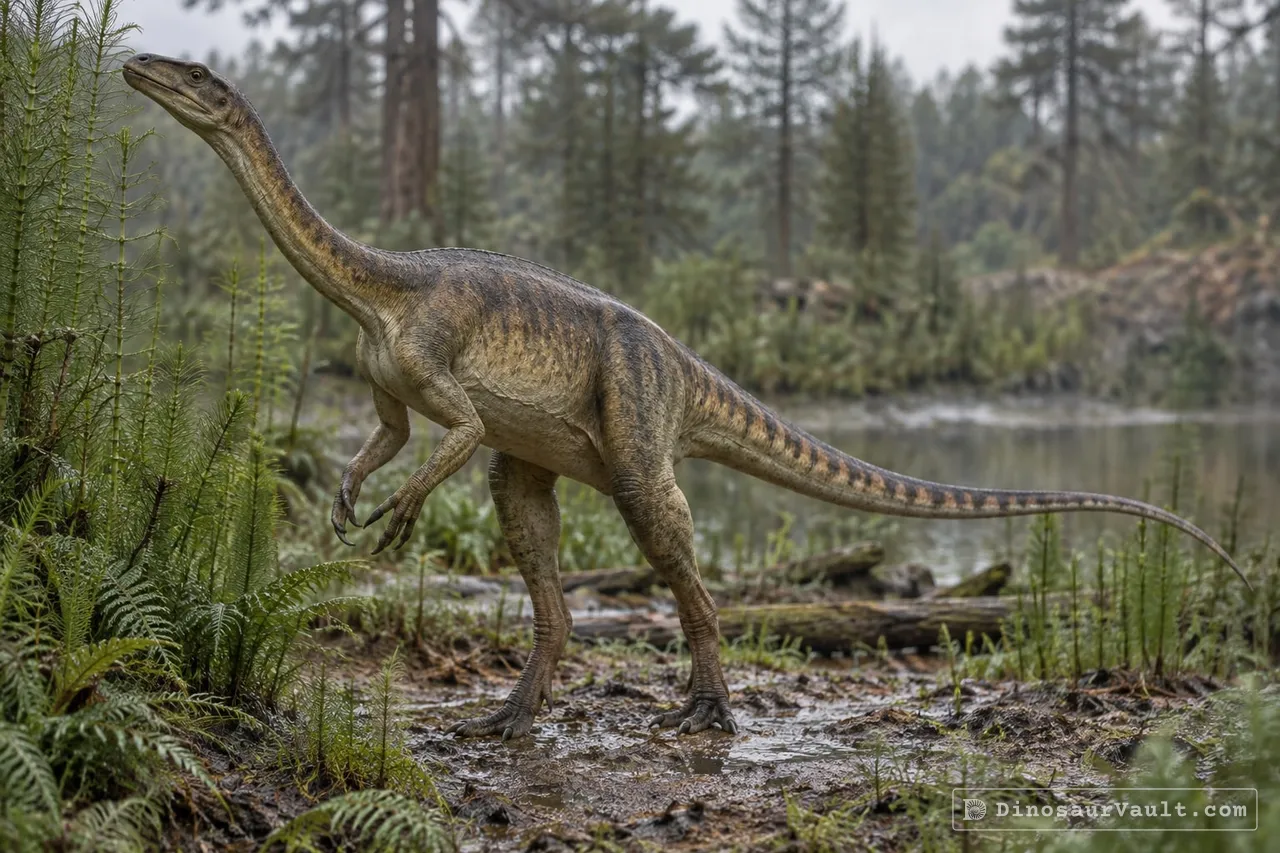
Scenes reconstructed from the available fossil evidence.
The evidence
The science behind Actiosaurus
Which parts of the picture come from its own bones, and which come from its relatives.
From its own fossils
- The surviving bones assigned to Actiosaurus come from the upper parts of the limbs.
- Their shapes resemble the limb bones of aquatic reptiles called choristoderes.
Borrowed from relatives
- Comparisons with choristoderes provide a possible model for the missing skull, trunk and tail.
Still unknown
- Which reptile group it belongs to, and whether it was a dinosaur at all.
- The shape and size of its complete body.
- What it ate.
Discovery timeline
- 1883Named itSauvage
- 1996Its worldCuny
- 2014RedescriptionFischer et al.
Key papers
The research behind what we know of Actiosaurus
Named it
Sauvage named Actiosaurus from fragmentary reptile bones found in France.
Recherches sur les reptiles trouvés dans l'étage rhétien des environs d'Autun [Research on the reptiles found in the Rhaetian stage of the environs of Autun]. Annales des Sciences Géologiques 14: 1-44
No link available
Its world
Studied regional vertebrate fossils and linked changes in animal communities to rising seas near the end of the Triassic.
French vertebrate faunas and the Triassic-Jurassic boundary. Palaeogeography, Palaeoclimatology, Palaeoecology 119: 343-358
Read the paper : French vertebrate faunas and the Triassic-Jurassic boundary (opens in a new tab)Redescription
Reexamined the surviving Actiosaurus limb bones, noted similarities to choristoderes and treated the species as needing further investigation.
Ichthyosaurs from the French Rhaetian indicate a severe turnover across the Triassic–Jurassic boundary. Naturwissenschaften 101: 1027-1040
Read the paper : Ichthyosaurs from the French Rhaetian indicate a severe turnover across the Triassic–Jurassic boundary (opens in a new tab)
Close relatives
Other members of Anchisauridae

Sources: Wikidata