Burianosaurus
"Burian's lizard"
Type species Burianosaurus augustai
- Lived
- 101 to 94 million years ago, Late Cretaceous
- Diet
- Herbivore
- Group
- Ornithopods
- Found in
- Czechia
- Named by
- Madzia et al. 2018
Where its fossils were found
The evidence
Today

95 million years ago
Habitat
It lived near the coast of an island in what is now Czechia. Salt marshes held shrubby conifers, while flowering plants grew on nearby river plains.
Field notes
About Burianosaurus
What it was like
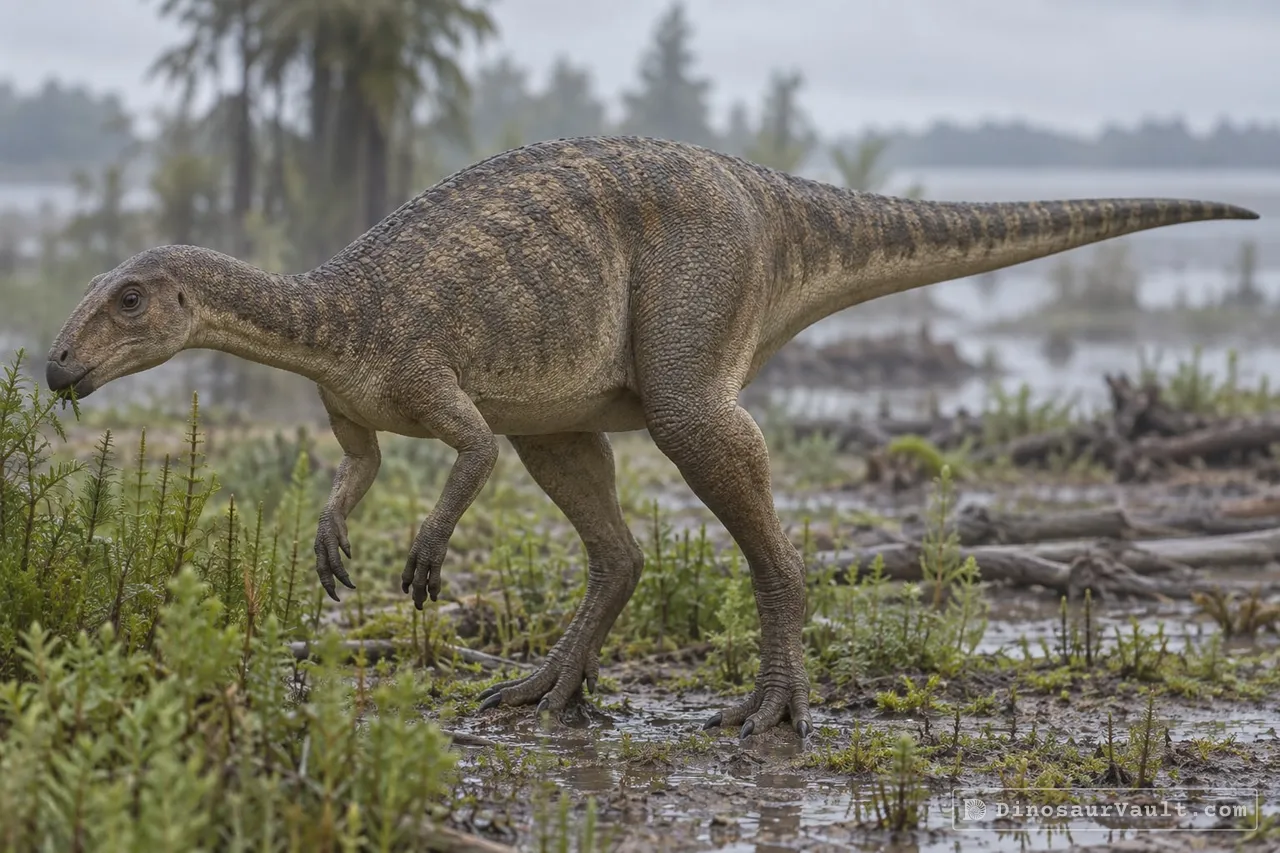
Burianosaurus was a small, two-legged plant eater known from a single thigh bone.
Its world
It lived in the Late Cretaceous in what is now Czechia. Europe was then a chain of islands. Its bone comes from the Peruc-Korycany Formation, which formed near the coast.
How it was found
Madzia and colleagues named it in 2018. The type species is Burianosaurus augustai. It was the first dinosaur named from Czechia, and it honors a well-known painter of prehistoric life.
Field gallery
More views of Burianosaurus
Scenes reconstructed from the available fossil evidence.
1 of 2
The evidence
The science behind Burianosaurus
Which parts of the picture come from its own bones, and which come from its relatives.
From its own fossils
- A nearly complete left thigh bone is the basis for its name.
- The thigh bone's shape places it among the early branches of the plant-eating ornithopods.
Borrowed from relatives
- The head, forelimbs and tail are restored by comparison with small plant eaters such as Hypsilophodon.
Still unknown
- Its skull shape and body proportions.
- Its skin covering and color.
- How its hatchlings looked and grew.
Discovery timeline
- 2015Family treeBoyd
- 2018Named itMadzia, Boyd & Mazuch
- 2021Family treeMadzia et al.
Key papers
The research behind what we know of Burianosaurus
Family tree
Compared the early branches of bird-hipped dinosaurs, providing a framework later used to test where Burianosaurus belongs.
The systematic relationships and biogeographic history of ornithischian dinosaurs. PeerJ 3: e1523
Read the paper : The systematic relationships and biogeographic history of ornithischian dinosaurs (opens in a new tab)Named it
Named a plant eater from a thigh bone and used its shape and microscopic structure to study its relationships and maturity.
A basal ornithopod dinosaur from the Cenomanian of the Czech Republic. Journal of Systematic Palaeontology 16: 967-979
No link available
Family tree
Defined the main branches of bird-hipped dinosaurs and included Burianosaurus among the early ornithopods in its reference family tree.
The phylogenetic nomenclature of ornithischian dinosaurs. PeerJ 9: e12362
Read the paper : The phylogenetic nomenclature of ornithischian dinosaurs (opens in a new tab)
Sources: Wikidata