Agnosphitys
"unknown begetter"
- Lived
- 237 to 227 million years ago, Late Triassic
- Group
- Early sauropodomorphs, Guaibasauridae
- Found in
- United Kingdom
- Named by
- Fraser et al. 2002
Where its fossils were found
The evidence
Today

230 million years ago
Habitat
It lived on land in what is now England, where sediment and bones filled cracks and cavities in limestone. Small crocodile relatives and lizard-like reptiles shared the region.
Field notes
About Agnosphitys
What it was like
Agnosphitys was a small animal from the Late Triassic, known from a few bones, including part of the hip, a jaw bone and an ankle bone. It may be an early dinosaur or a close relative of dinosaurs.
Its world
It lived in the Late Triassic in what is now England. Its bones come from cracks in limestone that filled with sediment and bones.
How it was found
Fraser and colleagues named Agnosphitys in 2002. The bones may come from more than one animal, so its place is uncertain.
Field gallery
More views of Agnosphitys
Scenes reconstructed from the available fossil evidence.
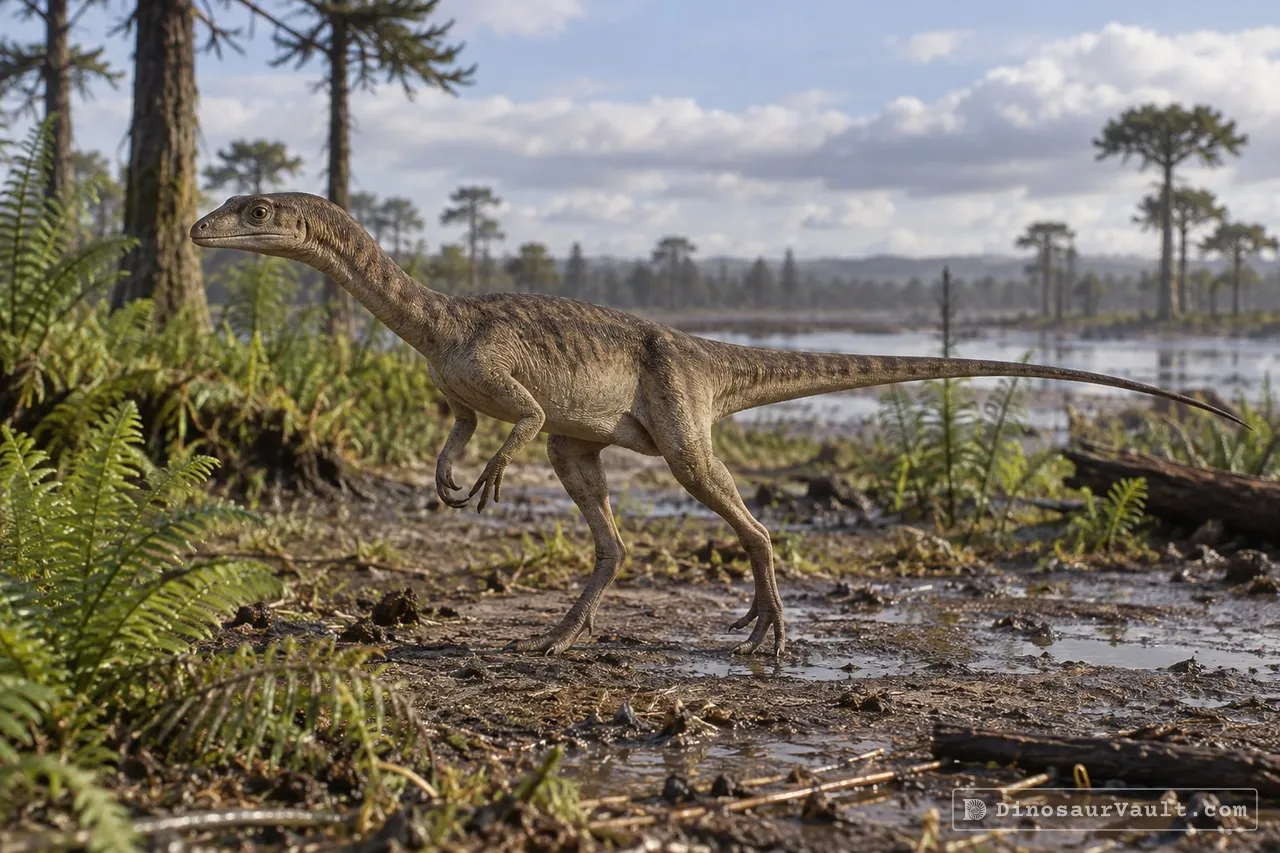
The evidence
The science behind Agnosphitys
Which parts of the picture come from its own bones, and which come from its relatives.
From its own fossils
- It was named from isolated bones, with the hip bone as the main specimen.
- Assigned ankle and upper arm bones have features shared with early dinosaurs.
Borrowed from relatives
- Most of the body must be restored by comparison with better-known early dinosaur relatives.
Still unknown
- Whether all the assigned bones belong to the same kind of animal.
- Whether it belongs within dinosaurs or just outside them.
- Its complete body shape, skin covering and color.
Discovery timeline
- 2002Named itFraser et al.
- 2010Family treeLanger et al.
- 2017Fossil sitesMorton et al.
Key papers
The research behind what we know of Agnosphitys
Named it
Described isolated hip and limb bones with dinosaur-like features and examined the boundary between dinosaurs and their close relatives.
Basal Dinosauriform Remains from Britain and the Diagnosis of the Dinosauria. Palaeontology 45: 79-95
Read the paper : Basal Dinosauriform Remains from Britain and the Diagnosis of the Dinosauria (opens in a new tab)Family tree
Reviewed early dinosaur evolution and identified the relationships of Agnosphitys as a continuing problem.
The origin and early evolution of dinosaurs. Biological Reviews 85: 55-110
Read the paper : The origin and early evolution of dinosaurs (opens in a new tab)Fossil sites
Studied small crustaceans from the fissure deposits to reassess their age and setting.
Biostratigraphy and geometric morphometrics of conchostracans (Crustacea, Branchiopoda) from the Late Triassic fissure deposits of Cromhall Quarry,UK. Palaeontology 60: 349-374
Read the paper : Biostratigraphy and geometric morphometrics of conchostracans (Crustacea, Branchiopoda) from the Late Triassic fissure deposits of Cromhall Quarry,UK (opens in a new tab)
Close relatives
Other members of Guaibasauridae

Sources: Wikidata